

How a STEM Program Strengthens the Mind – A Biological Perspective
The focus of education today is on how students think, not on what students memorise. An effective STEM education program helps meet this need by providing students with opportunities for structured problem-solving, experimentation, and critical analysis. Beyond its obvious academic value, cognitive science research has demonstrated that this type of learning is directly related to how the human brain grows and changes.
A STEM program does not “rebuild” the brain in a literal sense, but it creates learning conditions that strengthen neural pathways, improve cognitive efficiency, and enhance higher-order thinking skills through consistent practice and engagement.
Neuroplasticity
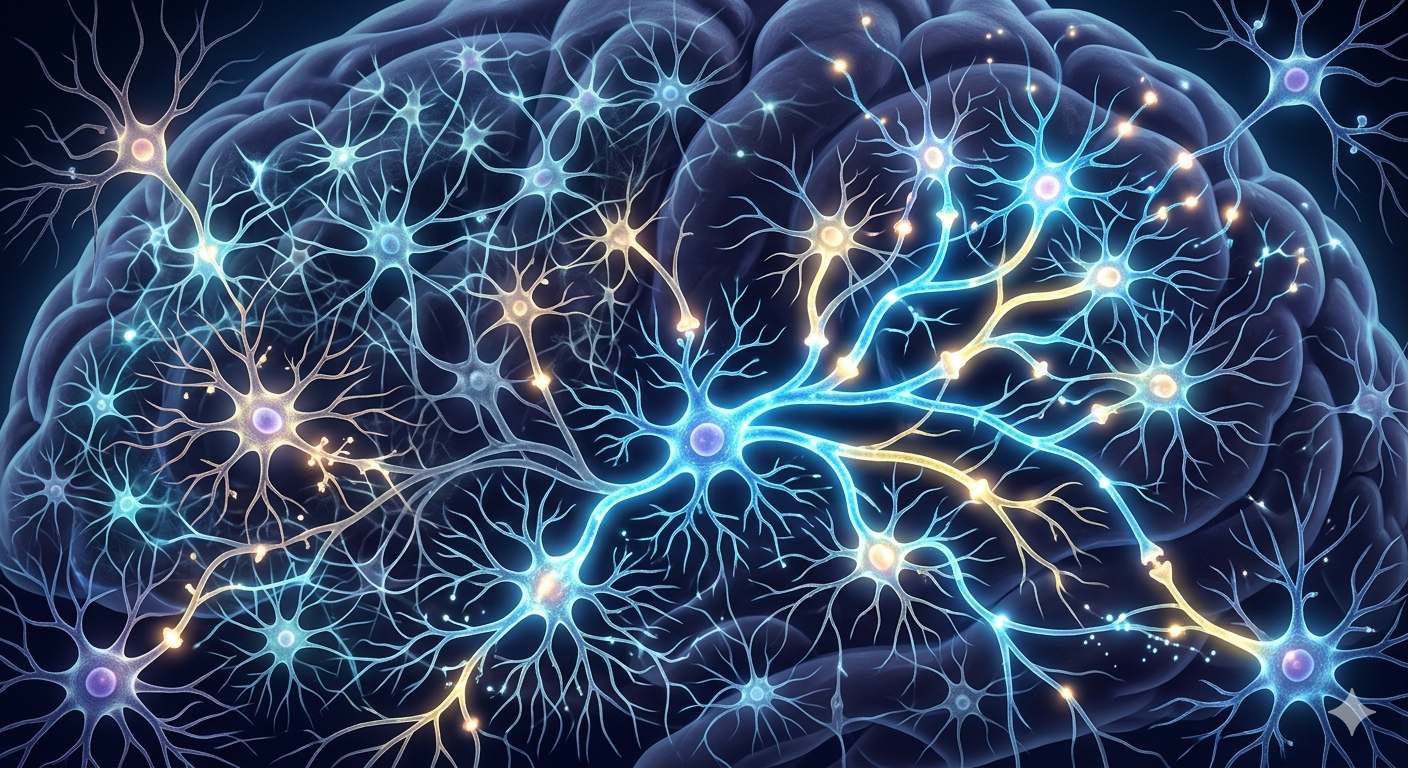
A key principle of brain science is neuroplasticity, which refers to the brain’s ability to adapt and reorganise based on experience. A STEM program supports this process by repeatedly exposing students to problem-solving and hands-on learning tasks.
How this supports learning:
- Repeated practice strengthens neural connections related to reasoning and analysis
- Hands-on activities support long-term retention of concepts
- Iterative experimentation improves adaptive thinking over time
- Continuous engagement enhances learning efficiency
Through regular exposure to challenges, students gradually become more comfortable with structured thinking and logical reasoning.
Prefrontal Cortex Engagement
The prefrontal cortex plays a central role in planning, decision-making, and logical reasoning. STEM-based activities naturally engage this part of the brain because they require structured thinking and evaluation.
Skills supported through this engagement:
- Planning multi-step solutions
- Evaluating possible outcomes
- Applying logic to real-world problems
- Making informed decisions based on evidence
When students work on experiments, coding tasks, or engineering challenges, they consistently practice these executive functions.
Working Memory
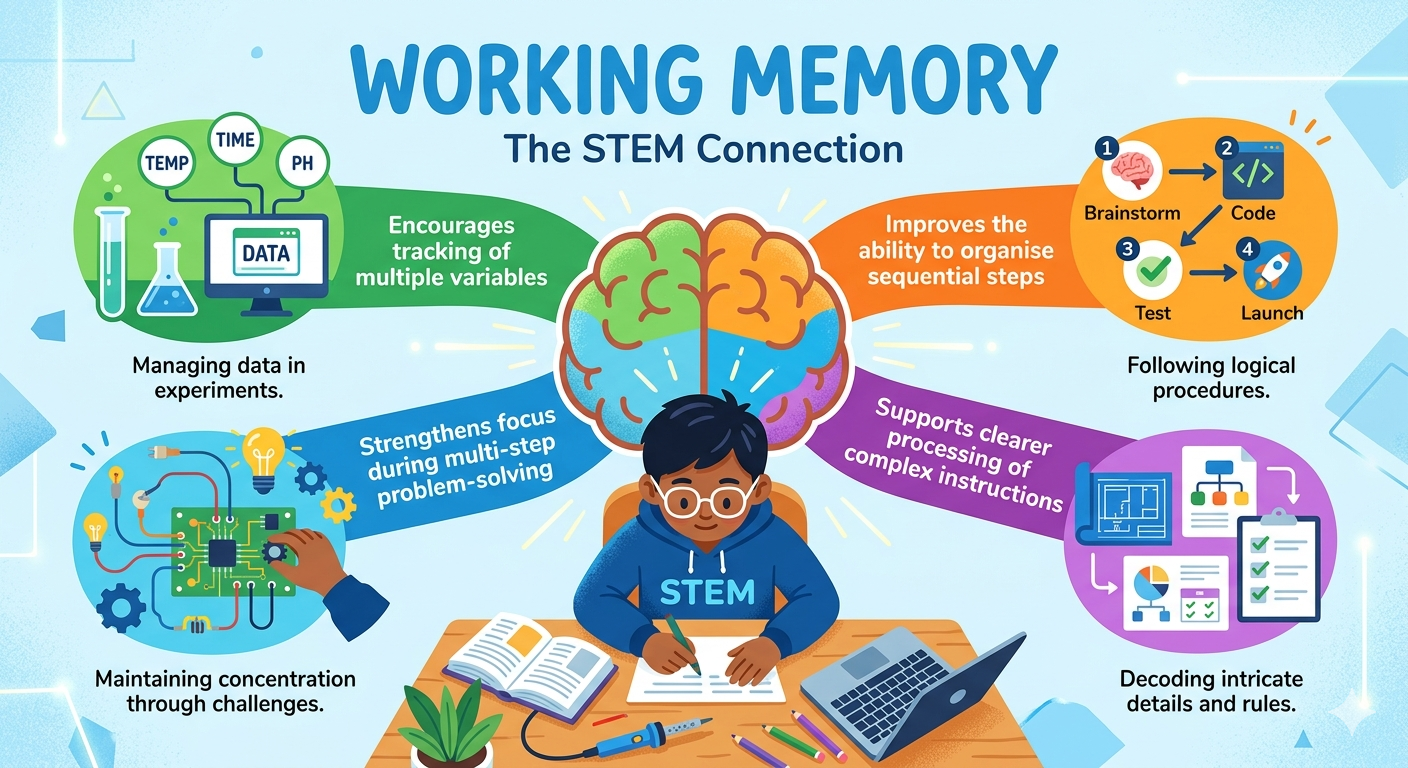
Problem-solving in a STEM program often requires students to manage multiple pieces of information at once. This engages working memory, which is responsible for temporarily holding and processing data.
How STEM learning supports working memory:
- Encourages tracking of multiple variables in experiments or tasks
- Improves the ability to organise sequential steps
- Strengthens focus during multi-step problem-solving activities
- Supports clearer processing of complex instructions
Over time, students become more efficient at managing information without becoming overwhelmed.
Motivation and Reward-Based Learning
Engaging STEM activities often involve achieving small milestones, solving challenges, or completing projects. These experiences are linked to the brain’s reward system, which plays a role in motivation and learning engagement.
Learning benefits include:
- Increased interest and sustained engagement in tasks
- Greater willingness to persist through challenges
- Stronger association between effort and achievement
- Improved focus during problem-solving activities
This helps students develop persistence, especially when tasks require multiple attempts or refinements.
Cognitive Load Management
A STEM program often introduces students to progressively complex problems. This helps them develop the ability to manage cognitive load, or the amount of information the brain processes at one time.
Key improvements:
- Breaking complex problems into smaller, manageable parts
- Prioritising relevant information over distractions
- Improving accuracy in step-by-step reasoning
- Enhancing mental organisation during problem-solving
This structured thinking approach is essential for both academic and real-world applications.
Integrated Thinking
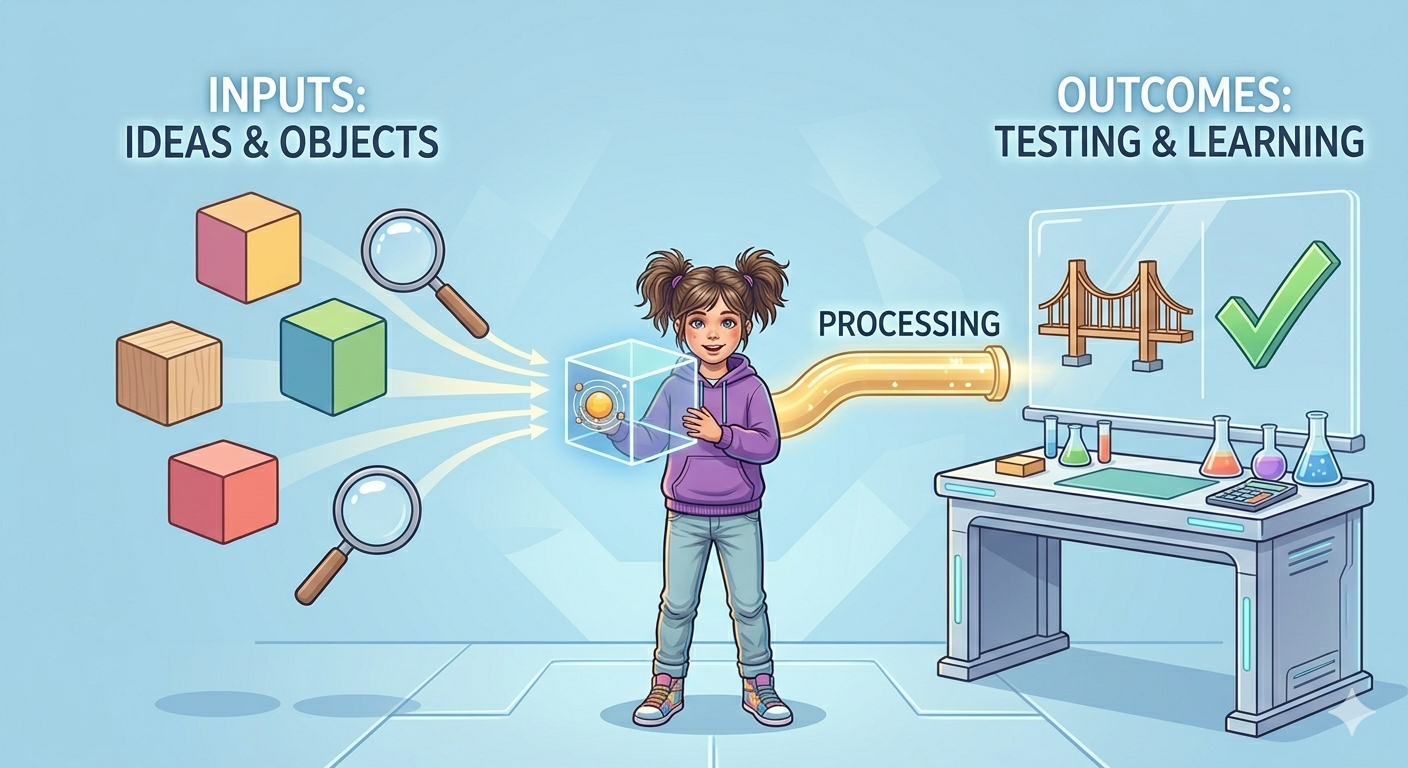
STEM learning naturally combines concepts from science, technology, engineering, and mathematics. This encourages students to think in an integrated way rather than viewing subjects in isolation.
Cognitive outcomes:
- Ability to connect ideas across different subjects
- Improved pattern recognition
- Better understanding of cause-and-effect relationships
- More flexible problem-solving approaches
This kind of learning supports holistic thinking, which is important for solving real-world challenges.
Stress and Learning Adaptation
Challenging tasks in a STEM program can help students gradually become more comfortable with problem-solving under pressure, especially when supported by a positive learning environment.
Observed learning effects:
- Improved confidence in handling difficult tasks
- Reduced hesitation in approaching unfamiliar problems
- Increased persistence when solutions are not immediate
- Better adaptability in changing situations
However, the effectiveness of this depends heavily on guided instruction and supportive teaching methods.
How Makers’ Muse STEM Resources Support Cognitive Development

Makers’ Muse provides a suite of STEM resources that are designed to deepen engagement, reinforce concepts, and encourage independent thinking. These contribute to the development of critical thinking and problem-solving skills within a STEM program. These resources are not just supplementary materials; they are structured to help learners apply knowledge, test ideas, and reflect on outcomes.
- Hands-On STEM Activities and Projects – These projects help learners apply scientific and engineering concepts in real situations.
- Maker Spaces and Innovation Labs – Dedicated spaces equipped with tools like 3D printers, robotics kits, and electronics components that let students prototype and iterate on designs.
- STEM Teaching Resources and Lesson Plans – Ready-to-use lesson plans, guides, and classroom activities that help teachers structure learning experiences focused on exploration and problem solving.
- Printable Worksheets and Assessment Tools – Worksheets and assessment resources that reinforce learning and help track students’ progress in STEM concepts.
- STEM Lab Makeover Ideas – Guidance and ideas to design and upgrade STEM labs, making learning environments more conducive to hands-on experimentation and collaborative problem solving.
- Community and Collaboration Support – A community space where educators and learners can share ideas, resources, and experiences to support ongoing STEM learning.
Conclusion
A STEM program is also beneficial in the development of critical thinking and problem-solving skills through the provision of a hands-on experience in a structured and inquiry-based manner. From biological and cognitive perspectives, this aligns with how the human brain naturally learns.
STEM learning environments are beneficial for the development of reasoning skills, memory, and thinking skills for students. Ultimately, a STEM program enables the students to go beyond memorisation and develop an adaptive and analytical thinking and problem-solving mindset.
Explore Makers’ Muse STEM resources today!