The Step-by-Step Guide to Writing Your First Research Paper as a School Student
Most students finish school with marks, assignments, and certificates. Very few graduate with something far more powerful – a published research paper.
That difference matters.
Today, universities and future employers increasingly value originality, critical thinking, and the ability to solve real-world problems. Students who can independently research, analyse data, and communicate ideas academically stand out immediately in competitive applications.
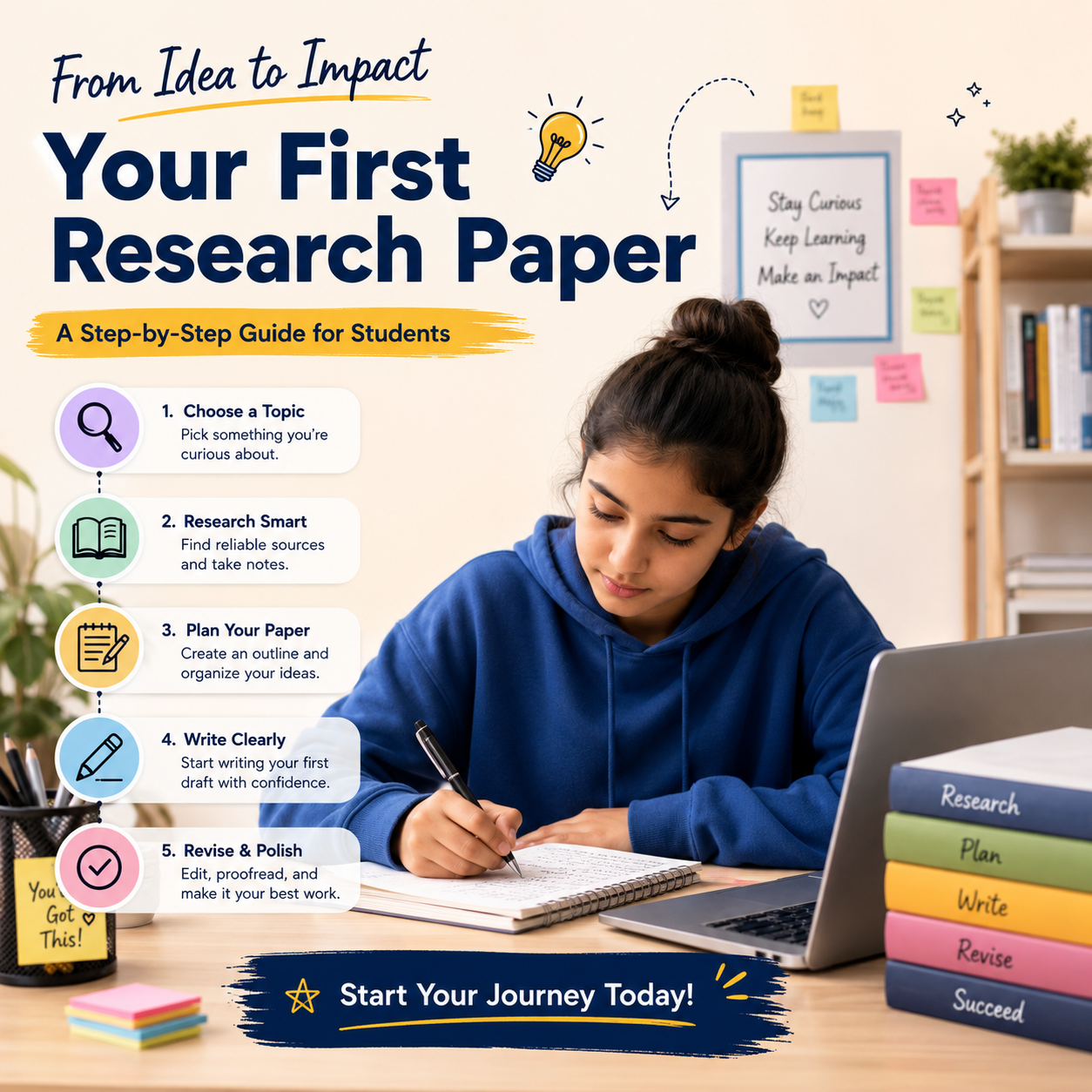
But here is the reality: most school students are never taught how to conduct genuine academic research.
This is exactly where the Young Scholars Research Program (YSRP) changes the game.
YSRP is not a school project programme. It is not a science fair activity. It is a structured academic mentorship experience designed to guide students through the complete lifecycle of real research – from idea selection to journal submission.
The programme helps students as young as Grade 6 learn how to think like researchers, work with expert mentors, and publish original papers in recognised academic platforms. If you are wondering how students actually write their first research paper, here is a complete step-by-step breakdown inspired by the YSRP framework.
What Is the Young Scholars Research Program (YSRP)?
The Young Scholars Research Program is a publication-first academic mentorship programme created for school students aged approximately 11-18.
The goal is simple:
Help students produce real academic research papers with expert guidance.
Unlike traditional school assignments, YSRP focuses on:
- Structured research methodology
- Domain-specific mentorship
- Academic writing
- Research execution
- Publication readiness
Students are matched with IIT researchers, PhD scholars, and industry experts who personally mentor them through every stage of the process. The programme is fully online, allowing students from any city to access high-level research mentorship.
8-Stage Research Journey
One of the strongest features of YSRP is its carefully designed 8-stage research journey, which simplifies research into achievable steps.
Step 1: Onboarding & Interest Mapping
Every strong research paper begins with curiosity.
In YSRP, students first go through an onboarding and interest-mapping stage where mentors identify:
- Academic strengths
- Areas of curiosity
- Long-term career interests
- Preferred research domains
This is important because research should never feel forced.
A student interested in AI may explore machine learning applications, while another passionate about sustainability may research urban pollution or renewable energy. Instead of assigning generic topics, YSRP helps students discover questions they genuinely care about solving.
At this stage, students also begin understanding the difference between:
- School projects
- Science fair models
- Real academic research
That distinction changes the entire learning experience.
Step 2: Research Question Framing
Once students identify their domain, the next step is transforming broad interests into strong research questions.
This is one of the most important parts of the research process.
A weak topic:
“Artificial Intelligence”
A strong research question:
“How can AI-based image recognition improve waste segregation in schools?”
YSRP mentors work closely with students to ensure questions are:
- Specific
- Researchable
- Original
- Academically meaningful
- Suitable for the student’s age and skill level
This stage teaches students how real researchers think: not by memorising answers, but by asking better questions.
Step 3: Literature Review
Before conducting original research, students must first understand what already exists. This stage is called the literature review.
In YSRP, students learn how to:
- Read academic papers
- Study journals and research databases
- Identify existing findings
- Detect gaps in current research
- Build annotated bibliographies
For many students, this is their first exposure to academic reading beyond textbooks.
Mentors guide them in understanding:
- Research terminology
- Citation styles
- Evidence-based thinking
- Academic credibility
This stage builds the intellectual foundation for the paper.
Step 4: Methodology Design
After defining the research question, students learn how to investigate it properly. This stage focuses on research methodology.
Depending on the domain, students may work on:
- Surveys
- Experiments
- Data collection
- Coding projects
- Simulations
- Statistical analysis
- Hardware prototypes
- Case studies
YSRP mentors help students choose methods that are both academically rigorous and practically achievable.
For example:
- A biology student may design a plant-growth experiment.
- A social science student may conduct behavioural surveys.
- A computer science student may build predictive models.
- An engineering student may create sensor-based systems.
Students also learn why methodology matters in credible research.
Step 5: Research Execution
This is where ideas become real work.
Students begin:
- Conducting experiments
- Running surveys
- Building systems
- Writing code
- Collecting datasets
- Recording observations
Unlike traditional school projects, YSRP emphasises:
- Documentation
- Consistency
- Academic discipline
- Mentor feedback
Students experience what authentic research feels like – including challenges, revisions, and problem-solving. This phase develops resilience, patience, and analytical thinking.
Step 6: Data Analysis
Collecting information is only half the process. Students must also understand what the data means.
During this stage, YSRP mentors guide students through:
- Pattern identification
- Data interpretation
- Statistical reasoning
- Visual presentation of findings
- Drawing evidence-based conclusions
Students may use:
- Excel
- Python
- Statistical tools
- Graphs and charts
- Comparative analysis frameworks
This step transforms raw information into meaningful academic insights.
Step 7: Paper Writing
Many students assume academic writing is impossible at their age. YSRP breaks the process into manageable sections.
Students learn how to write:
- Abstract
- Introduction
- Literature Review
- Methodology
- Findings
- Discussion
- Conclusion
- References
Mentors provide detailed feedback on:
- Structure
- Clarity
- Academic tone
- Logical flow
- Citation accuracy
The goal is not simply “finishing a document.” The goal is to produce a paper that is genuinely publication-ready.
Step 8: Review & Submission
The final stage focuses on preparing the paper for submission.
Students receive support with:
- Academic review
- Editing
- Formatting
- Journal alignment
- Submission standards
YSRP emphasises a publication-first approach, meaning students work toward an actual academic submission rather than just internal evaluation.
By the end of the programme, students leave with:
- A completed research paper
- Real academic exposure
- A verified research portfolio
- Publication experience
- Stronger university applications
- Advanced academic skills
The Domains Students Can Explore in YSRP
One reason YSRP stands out is the diversity of research domains available.
Students can pursue projects in areas such as:
- AI & Machine Learning
- Environment & Sustainability
- Health & Biomedical Sciences
- Robotics & Engineering
- Economics & Social Science
- Computer Science
- Biology & Life Sciences
- Physics & Space Sciences
- Linguistics & Humanities
This multidisciplinary approach allows students to align research with their genuine interests and future goals.
Why Research Experience Matters So Early
Research teaches students skills that classrooms often cannot:
- Independent thinking
- Critical analysis
- Academic communication
- Problem-solving
- Intellectual discipline
- Creativity with structure
More importantly, it helps students shift from passive learners to active creators of knowledge.
For university applications, research papers demonstrate:
- Initiative
- Depth of interest
- Long-term commitment
- Advanced academic capability
A published paper often becomes one of the strongest differentiators in competitive admissions.
Conclusion
Writing a research paper as a school student may sound intimidating at first, but with the right mentorship and structure, it can be achievable and transformative.
The Young Scholars Research Program (YSRP) by Makers’ Muse is helping students move beyond ordinary school projects into real academic research. Through its structured 8-stage mentorship process, publication-focused approach, and expert guidance, YSRP enables students to experience what genuine scholarship looks like long before university begins.
Because the future will not belong only to students who memorise information. It will belong to students who learn how to question, investigate, analyse, and create knowledge of their own.