
Hyundai & Boston Dynamics’ 2026 AI Robotics Strategy: How Schools Can Prepare Students for the Robot Revolution
At CES 2026, Hyundai Motor Group and Boston Dynamics didn’t just showcase cool robots – they unveiled a bold, human-centred AI robotics strategy that will reshape factories, logistics, and workplaces worldwide. From the next-generation Atlas humanoid robot to AI-powered co-workers like Spot and MobED, this partnership is accelerating the age of “Physical AI,” where intelligent machines work safely alongside humans. For schools, this isn’t just tech news; it’s a wake‑up call to prepare students for a future where robotics, AI, and human‑robot collaboration are everyday skills.
Hyundai & Boston Dynamics’ 2026 Vision
Under the theme “Partnering Human Progress,” Hyundai and Boston Dynamics are pushing AI robotics from the lab into real factories and cities. The star of the show is the new Atlas humanoid robot, now moving from research prototype to a commercially viable product version designed for manufacturing environments. Atlas will be deployed in Hyundai’s Metaplant America in Savannah, Georgia, starting in 2028, handling tasks like parts sequencing, and later moving to component assembly and heavy repetitive work.
Alongside Atlas, Boston Dynamics’ quadruped robot Spot is being used as an “AI Keeper” for quality inspection on automotive production lines, autonomously detecting defects and enabling immediate corrections. Hyundai is also rolling out MobED (Mobility Electric Device), an AI‑driven mobility platform for logistics and delivery, and integrating advanced AI chips (like DEEPX’s “edge brain”) to make robots smarter and more autonomous.
The big idea? Human-centred AI robotics – robots that don’t replace humans, but work with them, taking over dangerous, repetitive, or physically demanding tasks, while humans focus on supervision, creativity, and decision‑making.
What This Means for the Future Workforce
This strategy signals that the future workforce will need a very different skill set:
- AI & Robotics Literacy: Students must understand how robots sense, think, and act – not just as users, but as designers and operators.
- Human‑Robot Collaboration: Future jobs will require knowing how to work safely and effectively with robots, giving commands, interpreting data, and handling exceptions.
- Problem‑Solving & Adaptability: Robots will handle routine tasks; humans will solve complex problems, optimise processes, and innovate.
- Ethics & Safety: As robots become more autonomous, students must also learn about AI ethics, data privacy, and safety in human‑robot environments.
How Schools Can Prepare Students
To truly prepare students for this robot revolution, schools need to move beyond theory and build hands‑on, future‑ready experiences:
- Integrate Robotics & AI into the Curriculum
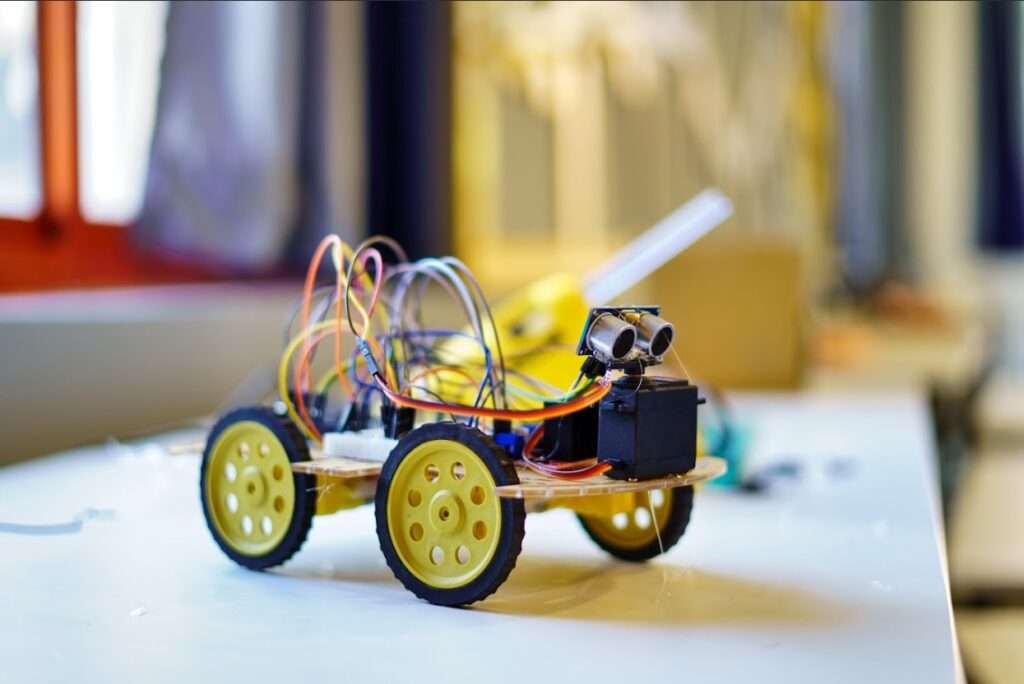
- Start early with block‑based coding (Scratch, PictoBlox) and simple robots (line followers, obstacle avoiders).
- In middle and high school, introduce AI concepts (machine learning, computer vision, NLP) through projects like smart traffic lights, AI‑based games, or simple chatbots.
- Create Real‑World Robotics Labs
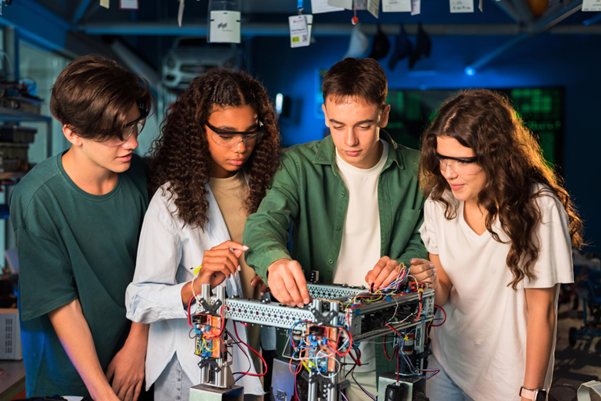
- Set up labs with humanoid or quadruped‑style educational robots (or simulators) where students can program movement, sensing, and decision‑making.
- Use platforms like Arduino, micro: bit, or Raspberry Pi to build robots that mimic real industrial tasks (sorting, inspection, delivery).
- Focus on Human‑Robot Collaboration Projects
- Design projects where a robot and a human “team” solve a problem together – e.g., a robot scans a model factory floor while a student analyses the data and makes decisions.
- Run challenges like “Design a Robot Assistant for a Factory Worker” or “Create a Safe Human‑Robot Workspace.”
- Teach AI Ethics and Safety
- Include modules on AI bias, data privacy, and the social impact of automation.
- Discuss real cases like Hyundai’s Atlas deployment and ask: “What jobs will change? How can we ensure fair and safe workplaces?”
- Connect to Industry and Careers
- Invite engineers and robotics experts to talk about real‑world applications.
- Show students career paths in robotics engineering, AI development, robotics operations, and human‑robot interaction design.
The Bottom Line
Hyundai and Boston Dynamics’ 2026 AI robotics strategy is not science fiction – it’s the near‑term future of work. Schools that respond by building strong robotics and AI programs, emphasising collaboration, ethics, and real‑world problem‑solving, will give their students a massive advantage. The robot revolution is here; the question is not if, but how well prepared the next generation will be to lead it.