300 Teen Scientists Named in Regeneron STS 2026! What Their Projects Mean for Global STEM
In a powerful reminder of what young minds can achieve, the Regeneron Science Talent Search (STS) 2026 has announced its 300 scholars — 300 high school seniors whose groundbreaking research is already tackling some of the world’s toughest problems in AI, health, climate, and space. Often called the “Junior Nobel Prize,” Regeneron STS is the USA’s oldest and most prestigious science and math competition for high schoolers, and this year’s cohort shows how deeply teens are engaging with real‑world STEM challenges.
Who Are the Regeneron STS 2026 Scholars?
The 300 Regeneron STS 2026 scholars come from 206 schools across 35 U.S. states and a few international schools, representing a diverse mix of backgrounds, interests, and research areas. These students are not just “good at science” — they are independent researchers who have spent months or even years designing, running, and analyzing original projects in fields like:
- Artificial intelligence and machine learning.
- Biomedical engineering and rare disease therapies.
- Climate science and environmental sustainability.
- Astrophysics, quantum computing, and advanced mathematics.
Each scholar submitted a detailed research paper, and the top 40 are invited to Washington, D.C. for the final round, where they present their work to leading scientists and compete for millions in scholarships.
What Kind of Projects Are Teens Working On?
This year’s projects reflect the urgent, complex challenges of our time. Some standout themes include:
- AI & Machine Learning: Students are building AI models to classify celestial objects in telescope data, predict disease outbreaks, and optimize energy use in buildings.
- Health & Biotech: Projects range from creating fruit‑fly models of rare genetic diseases to designing low‑cost diagnostic tools and drug delivery systems.
- Climate & Environment: Teens are studying microplastics, developing sustainable materials, and creating models to predict extreme weather and sea‑level rise.
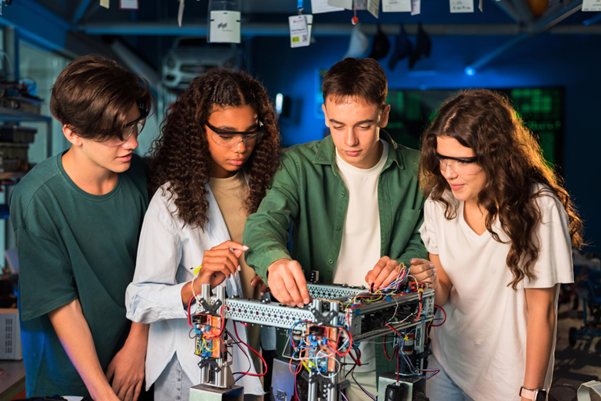
- Engineering & Robotics: From custom flight computers for oblique‑wing aircraft to advanced algorithms for neutrino detection, students are pushing the limits of what’s possible in hardware and simulation.
These aren’t school science fair projects; they are sophisticated, peer‑review‑style investigations that often get published or presented at national conferences.
Why This Matters for Schools and STEM Education
For schools, STEM labs, and Atal Tinkering Labs, the Regeneron STS 2026 scholars are a goldmine of inspiration. Their work shows that:
- Real research is possible in school: With the right support, mentorship, and lab access, students can move beyond textbook experiments to original, publishable research.
- Interdisciplinary thinking wins: The best projects combine biology, coding, math, and engineering — exactly the kind of cross‑subject learning that NEP 2020 and NCF 2023 emphasise.
- Ethics and impact matter: Many projects focus on “AI for Public Good,” rare disease cures, and climate justice, showing that the next generation of scientists cares deeply about using STEM for social good.
How Indian Schools Can Use This Story
For Indian educators and STEM coordinators, the Regeneron STS 2026 story is a powerful hook to:
- Motivate students: Share videos and project summaries of the scholars to show that “real science” is within reach. youtube
- Design advanced projects: Challenge students to create “Regeneron‑style” projects in their ATLs — original research on local problems in health, environment, or AI.
- Build a research culture: Introduce simple research methods (hypothesis, data collection, analysis) even in middle school, so students are ready for serious projects by Class 11–12.
The Bigger Picture: Teens Shaping the Future
The 300 Regeneron STS 2026 scholars are more than just winners — they are a preview of the future. They prove that when students are given curiosity, tools, and mentorship, they can already contribute meaningfully to science, technology, and society.
For schools and STEM labs, the message is clear: the next big breakthrough in AI, health, or climate may not come from a university lab, but from a high school student’s project in a classroom or makerspace.