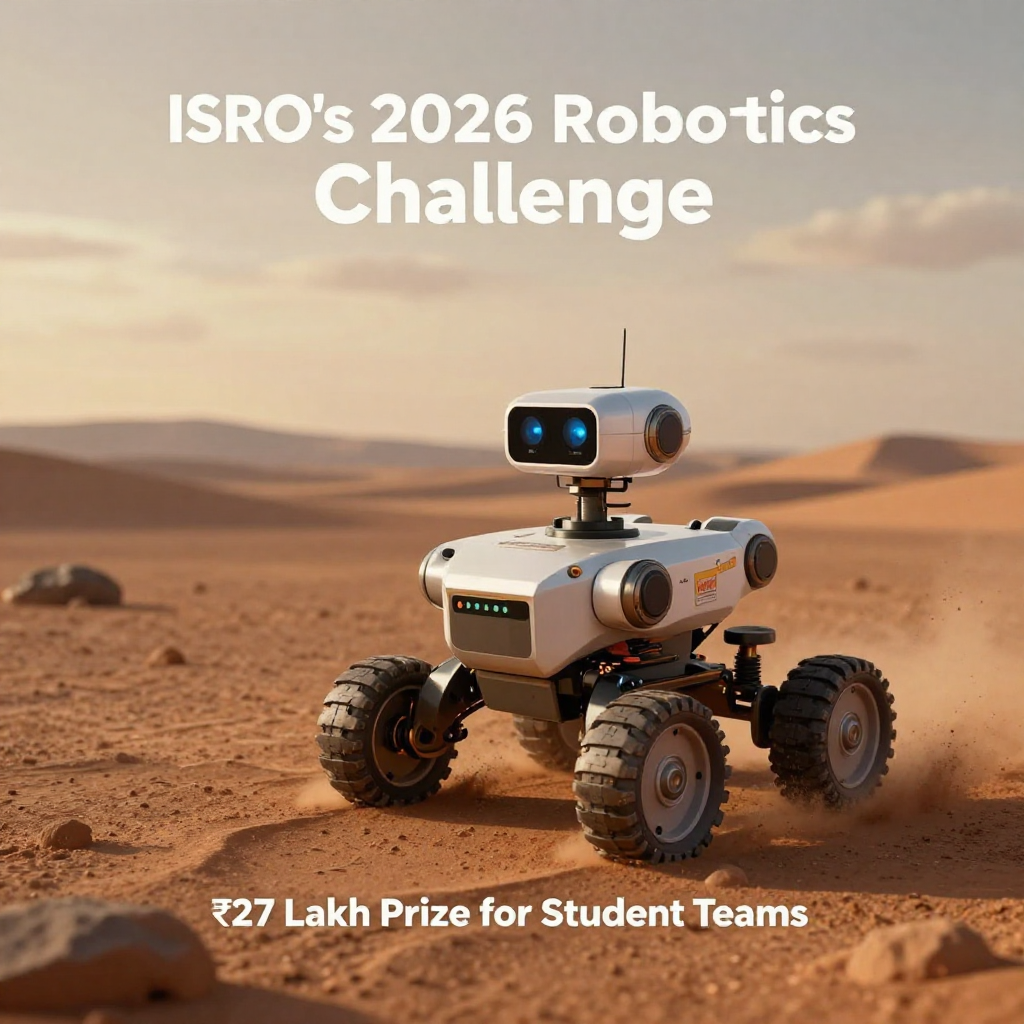
ISRO’s 2026 Robotics Challenge: ₹27 Lakh Prize for Student Teams Building Mars‑Style Robots
ISRO is launching Indian students into the next big leap in space robotics with the ISRO Robotics Challenge 2026 (IRoC‑U 2026), offering a massive ₹27 lakh prize pool for student teams building Mars‑style autonomous robots that can survey, navigate, and land on Mars‑like terrain — all without GPS or external help.
Organised by ISRO’s U R Rao Satellite Centre (URSC), Bengaluru, the challenge is designed like a real planetary mission: teams must develop an autonomous micro‑UAV (a small drone) and a base station that can explore an extra‑terrestrial arena, find safe landing spots, identify target features like rock formations, and then return to base to recharge and transfer data — exactly what future robots on Mars or the Moon must do.
Theme: “ASCEND” – A Mars‑Style Surveyor Robot
The 2026 challenge is themed “ASCEND” — Autonomous Surveyor Challenge for Exploration, Navigation, and Dynamics — mimicking the conditions of Martian exploration.
Students are being asked to build a robot that can:
- Take off and land vertically (VTOL) from its base station.
- Navigate and map a Mars‑like arena using vision and sensors, not GPS/GNSS, pseudolites, or reflector arrays.
- Identify safe zones for landing and spot specific target features (like rocks, areas of interest).
- Return to base, dock, transfer image and location data, and self‑recharge.
- Perform multiple sorties (repeats) fully on its own, without remote control or telemetry.
The focus is not on fabricating a fancy drone, but on developing the “brain” of the robot: autonomous navigation, computer vision, localisation, and swarm‑like decision‑making for space missions.
₹27 Lakh Prize: India’s Biggest Robotics Boost for Students
ISRO is backing this challenge with a total prize pool of ₹27 lakh, aimed at rewarding the most innovative and robust autonomous systems built by Indian students.
- The winning team will take home ₹10 lakh, one of the largest single prizes for a student robotics competition in India.
- Additional cash rewards will go to runners‑up and other top teams across different task categories.
Winners will be formally recognised during National Space Day celebrations on August 23, 2026, giving their institution and mentors a special moment of pride on a national platform.
Who Can Participate & How to Apply
The challenge is open to institutional student teams from engineering colleges, polytechnics, and technical institutions across India.
- Each team must have 3 to 10 members from the same institution.
- Teams must submit a preliminary design proposal by the deadline (December 2025 / January 2026 window).
- After shortlisting, teams go through a multi‑stage elimination process, including design reviews and field trials.
The final, high-stakes field round will be held at URSC’s campus in Bengaluru in July 2026, where the top teams will demonstrate their robots in a Mars‑simulation arena.
A Real‑World Mission Simulator for Future Space Engineers
ISRO has made it clear: IRoC‑U 2026 is not just a robotics competition; it’s a training ground for India’s future space roboticists.
The challenge is specifically designed to solve real hurdles in planetary exploration:
- How to navigate on Mars without GPS or communication relays.
- How to let a robot explore unknown terrain safely and autonomously.
- How to gather scientific data and bring it back reliably for analysis.
By focusing on algorithms, vision‑based navigation, and autonomy rather than just hardware, ISRO is pushing students to think like space engineers and AI/robotics researchers.
Why Schools and Colleges Should Pay Attention
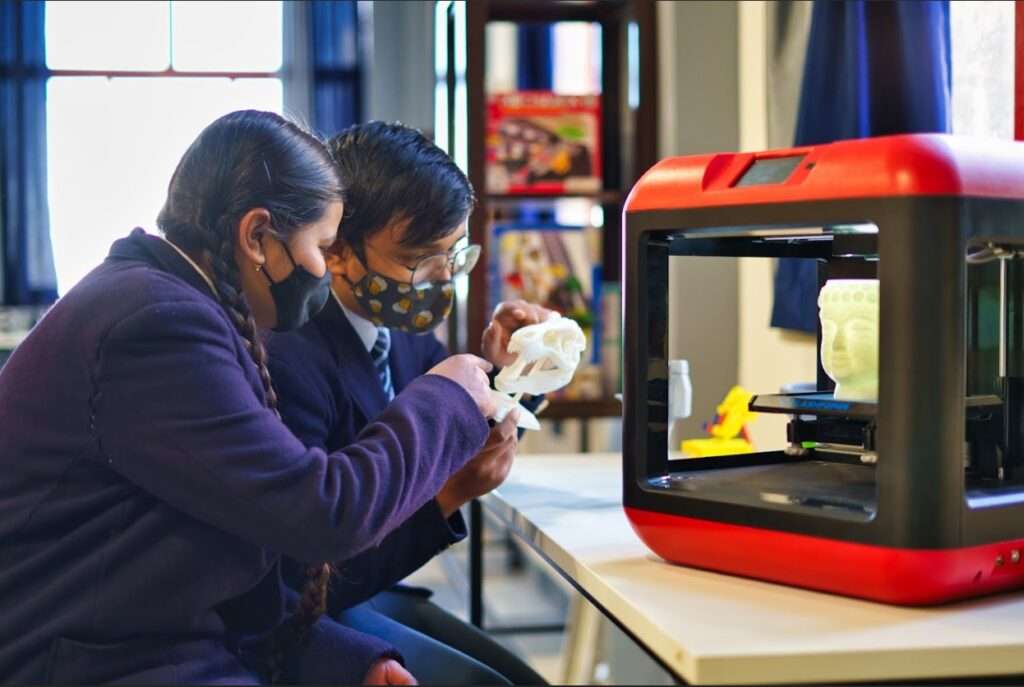
For schools and STEM Education labs, this challenge is a golden opportunity to:
- Excite students about careers in robotics, AI, and space technology.
- Turn the school’s robotics club into a launchpad for national recognition.
- Use the challenge as a project‑based learning module in robotics, coding, and electronics.
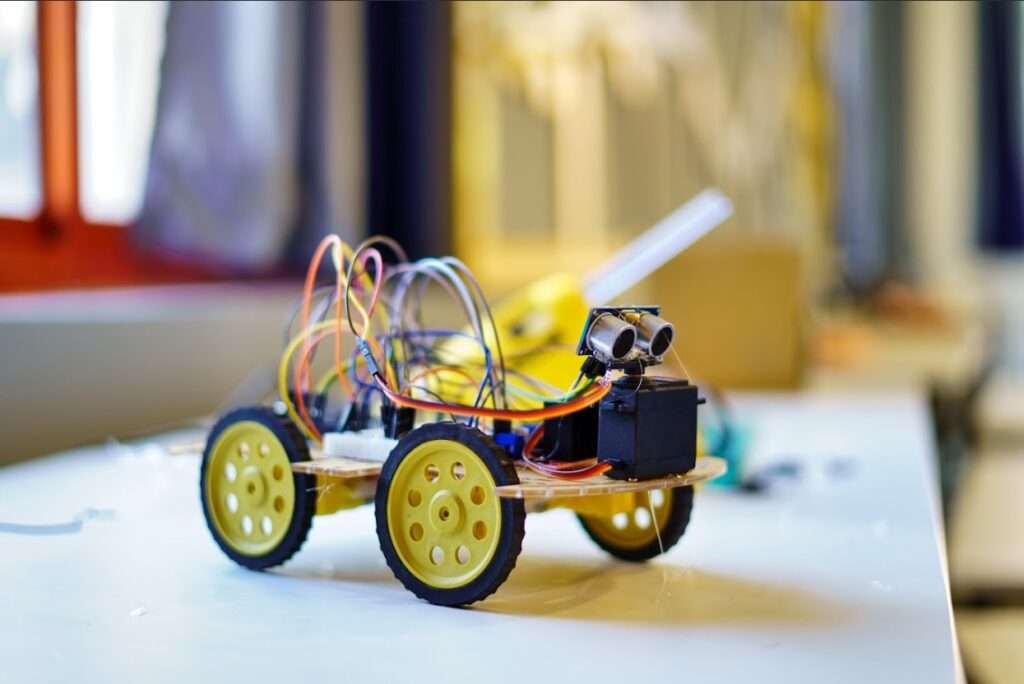
Even if a school cannot field a full IRoC‑U team, they can build smaller “mini‑ASCEND” projects in their labs: simple drones that avoid obstacles, map small areas, or return to a base using sensors and basic autonomy — all aligned with India’s growing space ambitions.
How to Prepare: From Concept to Mission
ISRO encourages teams to:
- Use off‑the‑shelf drones that comply with DGCA rules, rather than building from scratch.
- Focus on programming the “brain” (autonomous navigation, vision, control logic) using open‑source stacks.
- Start with small simulations and indoor field tests before scaling up to larger arenas.
URSC also provides detailed documentation and guidelines on its official challenge portal, helping student teams understand the tasks, rules, and evaluation criteria clearly.
For Indian students dreaming of working in space robotics, ISRO Robotics Challenge 2026 is not just a competition — it’s their first real mission to another planet, right here on Earth.