Global Classrooms Are Here! Indian Students Now Learning Robotics with Foreign Peers
It started with a simple message in a WhatsApp group:
“Team from India, meet Team from Brazil. Challenge: build a robot that helps elderly people in disaster-affected areas. Let’s connect at 7 PM IST.”
No visa, no flight tickets, no embassy forms.
Just screens, a few shared project files, and a shared mission: build, code, and collaborate like a real international robotics team.
This is not sci-fi. This is the new face of STEM education in 2026, where classrooms are no longer limited to four walls but are unfolding across continents, and Indian students are at the forefront of the global robotics movement.
The Rise of the Global Robotics Classroom
In the past, “international robotics” meant sending a winning team from India to a foreign competition, with only a handful of students experiencing the global stage.
Today, the game has changed.
From Class 8 to college, students are:
- Joining UN-based global robotics competitions like the Robotics for Good Youth Challenge, where Indian teams design robots for disaster response and then virtually compete with schools from dozens of countries.
- Preparing for events like World Robot Olympiad 2026 (WRO), whose theme “Robots Meet Culture” asks teams to create robots that preserve heritage and share human stories across cultures.
- Participating in open, internet-based contests like e-Yantra Robotics Competition (eYRC), where engineering teams from India and other countries collaborate on robotics tasks involving drones, ROS, and AI, all from their own labs and colleges.
Schools are no longer asking, “Can we send a team abroad?”
They’re now asking, “How can we make every student in our robotics club feel like they’re part of the world?”
How It Actually Works
Imagine a robotics lab in Hyderabad.
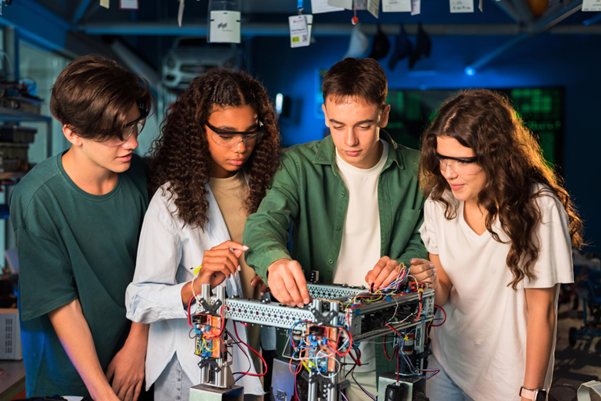
A Class 10 team is working on a robot that detects water pollution. Over the next month, they:
- Connect with a partner school in a European country over a secure video platform.
- Share designs, code, and test data in a common cloud workspace.
- Run identical test scenarios in their respective labs (same challenge, same sensors, same robot mission).
- Present their joint project to a combined panel of Indian and foreign teachers and mentors.
They’re not just building robots;
They’re learning international collaboration, cross-cultural communication, and how to solve real-world problems with peers from different time zones and educational backgrounds.
What’s Driving This Shift?
Three big forces are pushing schools into global robotics classrooms:
- Affordable Technology
- With good internet, a simple video call, and shared cloud tools (Google Workspace, Discord, GitHub Education), schools can now run low‑cost “global classrooms” without huge budgets.
- Global Competitions with Indian Keys
- Events like WRO and Robotics for Good are now structured with virtual and hybrid rounds, making it easier for more Indian students to participate as part of an international community, not just as finalists.
- ISRO’s own robotics challenges and national robocons are also inspiring students to think globally while working locally.
- Schools Building “Global Hubs”
- Forward‑thinking schools are now setting up “Global STEM/Robotics Labs” where students don’t just learn from teachers, but from foreign students, AI tutors, and international problem statements (e.g., robots for climate, disaster, health).
What Does This Mean for Indian Schools?
The message is clear: the future of robotics is collaborative and global.
Every school in India now has a real opportunity to:
- Run international robotics exchange programs (even if only virtual) with partner schools in Southeast Asia, the Middle East, or Europe.
- Train teachers to mentor students who communicate with foreign peers, write global project reports, and present in English or other international formats.
- Use themes like “Robots for Culture” or “Robotics for Good” to link STEM with storytelling, social issues, and global citizenship.
The Future Is Local + Global
The next big innovation in robotics won’t come from one lab in one country.
It’ll come from a joint team of students in India, Brazil, Kenya, and Norway, working together on a shared challenge, sharing ideas across borders.
For Indian students, the good news is:
You don’t have to wait for a scholarship or a foreign college.
Your school’s robotics lab can already be a global classroom.
All you need is curiosity, a few connected devices, and the courage to say:
“Hello, Team from abroad. Let’s build something amazing together.”
At MakersMuse, we’re here to help every school in India become a node in this global network of robotics. Because in 2026, the next big robot might not be built in one country, but by a classroom that spans the entire world.