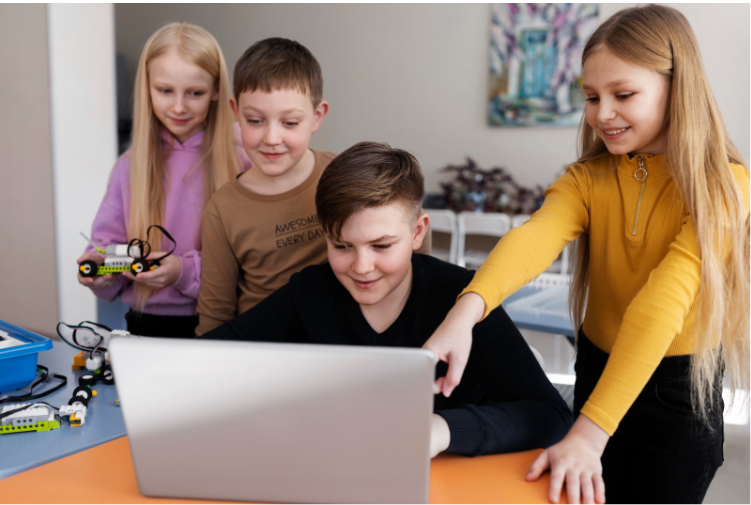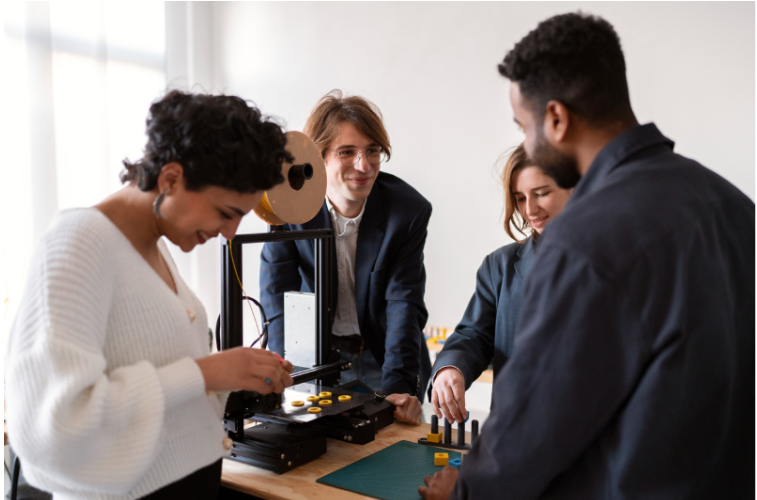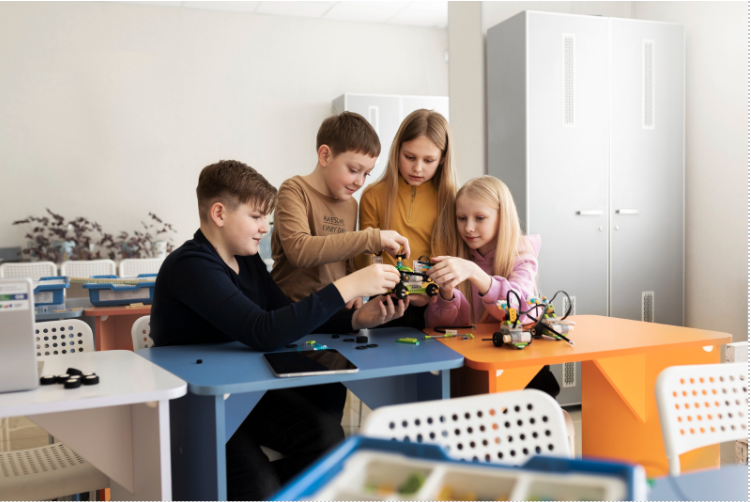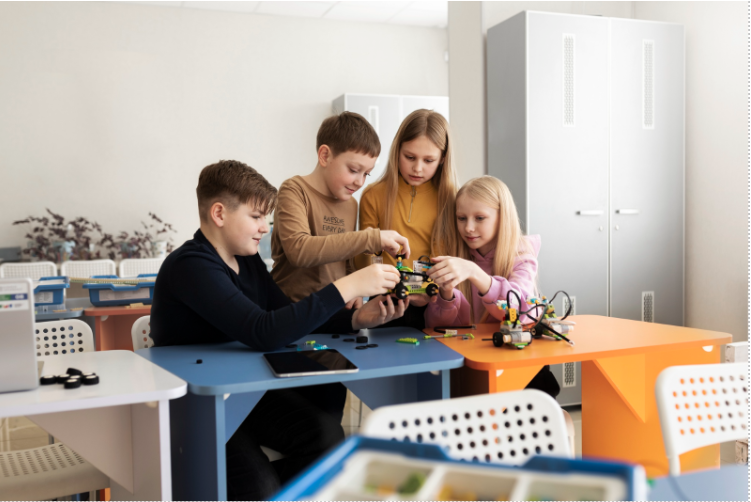


A kid spends an hour wiring a sensor to a motor, gets it wrong four times running, and finally gets it right on the fifth try. That’s not really an electronics lesson. It’s a lesson in sticking with something that isn’t working yet, which is the honest core of what the benefits of robotics in education actually come down to. Not flashy demos. The habits built by wrestling with something physical and stubborn until it cooperates.
Skills Robotics Actually Builds
Problem-Solving Through Something Physical
A robot veers off its line, and there’s no faking your way past that. Something specific is wrong, a sensor’s angled slightly off, a calibration number’s out of range, a wire worked itself loose, and finding out which one it is teaches a kind of hunting-down-the-problem patience that’s oddly hard to get from a written assignment. Nobody gives partial marks for a wrong answer that merely sounds reasonable here. Either it moves right, or it doesn’t.
Coding Logic Made Tangible
For students who find abstract programming exercises dull, watching code directly steer a physical object changes things. A loop that fires one time too many sends a robot straight into a wall instead of just printing an extra line to a console somewhere. Among the advantages of robotics education, this visible link between logic and consequence gets reported consistently by teachers who’ve actually taught both kinds of classes side by side.
Engineering Thinking, Introduced Early
Almost without meaning to, robotics drags students through the actual engineering cycle, pick a problem, build something rough, test it, watch it fail in some new and annoying way, fix it, try again. Do that enough times across a year and something shifts. Failure stops feeling like a verdict and starts feeling like the next step, a habit that sticks around long after the robot itself gets packed away.
Creativity Within Real Constraints
Robotics occupies an interesting spot, genuinely creative, but bounded hard by physics, available parts, and whatever’s actually buildable. That constraint is part of the value, not a limitation on it. A student working out how to solve a problem with three servos and a tight budget of spare parts is practising a specific kind of creativity that open-ended art projects don’t always demand in the same way.
Where the Impact Shows Up Beyond the Robot Itself
Teamwork That Actually Matters to the Outcome
Group robotics projects force real collaboration in a way plenty of group assignments simply don’t, because a robot with mismatched wiring or contradictory code won’t function, full stop, no matter how well each student worked in isolation. Roles tend to emerge on their own too. One student drifts toward the mechanical build, another toward the code, another toward testing and writing things down, and the team has to genuinely coordinate or nothing moves.
Real-World STEM Application
Robotics ties abstract STEM ideas, physics, geometry, basic electronics, to something a student can actually see and touch. A lesson on torque lands differently once it’s the exact reason a robot’s wheels are too weak to climb a small ramp. That applied, visible connection is a big part of what educational robotics benefits actually rest on.
Engagement That Tends to Hold Up
Robotics sustains interest longer than a lot of classroom activities, partly because progress is visible and partly because failure shows up immediately rather than three weeks later on a graded test. That said, engagement varies quite a bit by student, and it’s worth not assuming it’s universal.
Early Career Exposure
Robotics gives students a low-stakes preview of engineering, computer science, and applied STEM work well before any real decision has to get made about which subjects to chase further. A student discovering they love the mechanical side, or actively dislike it and prefer the coding half, has learned something genuinely useful about themselves, years earlier than it would otherwise come up.
Confidence Built From Visible Wins
Forty minutes of a robot refusing to do the one thing it’s supposed to do, and then, finally, it does. Nobody needs to tell that kid it was good work. They watched it happen. For a student who’s spent years losing points on tests built around speed or rote memorisation, that’s a different kind of proof entirely, one that doesn’t run through anyone else’s red pen. Something about that carries forward too, into whatever hard thing shows up next, robot or not.
Reaching Students Traditional Classrooms Overlook
Watch a robotics session for a while and a pattern shows up fast: some of the kids doing best here are the exact ones who struggle hardest through a normal lecture and worksheet block. Not a coincidence, that. Give a restless kid something physical to poke at, adjust, and watch react, and thirty minutes of squirming through an explanation turns into total focus, no transition period needed.
Kinesthetic learners get shortchanged constantly, and there are more of them sitting in any given classroom than most timetables account for. Then there’s the other group worth naming, students who’ve spent years falling behind in text-heavy subjects and quietly decided somewhere along the way that school just “isn’t for them.” Robotics doesn’t ask anyone to be a fast reader or a strong writer first. It just asks them to notice what’s going wrong and try something else, which happens to be a far more level playing field than most classroom activities manage.
None of this means robotics fixes every learning gap on its own, and it’s worth being careful not to overstate it. But schools looking to reach students who’ve disengaged elsewhere often find this particular thread among the benefits of robotics in education, reaching kids nothing else in the timetable quite reaches, worth building the whole program around.
Where Makers’ Muse Fits In
Makers’ Muse focuses on the kind of robotics learning benefits that actually hold up under scrutiny: sustained project work, real troubleshooting, genuine teamwork, rather than one-off demos that look impressive and teach little.
FAQs
Yes, to a degree. Problem-solving, teamwork, and iterative thinking transfer well beyond STEM subjects, even for students who never pursue engineering or computer science further.
Yes, with age-appropriate expectations. Younger students benefit most from the problem-solving and creativity side, while more technical coding and engineering benefits tend to strengthen from middle school onward.
Some evidence points to gains in related areas like maths and physics, though the research isn’t strong enough to claim robotics alone drives broad academic improvement.
Sustained exposure over a school term or longer tends to show far more benefit than a single workshop or short one-off session.