
Makers' Muse presents
Robotics Lab for Schools: Hands On Robotics, Coding & Innovation
Ask a lab in charge what’s gathering the most dust in the storage cupboard, and the honest answer, more often than not, is a robotics kit. Opened once for the launch photo, never touched again, because nobody left behind a reason to open it a second time.
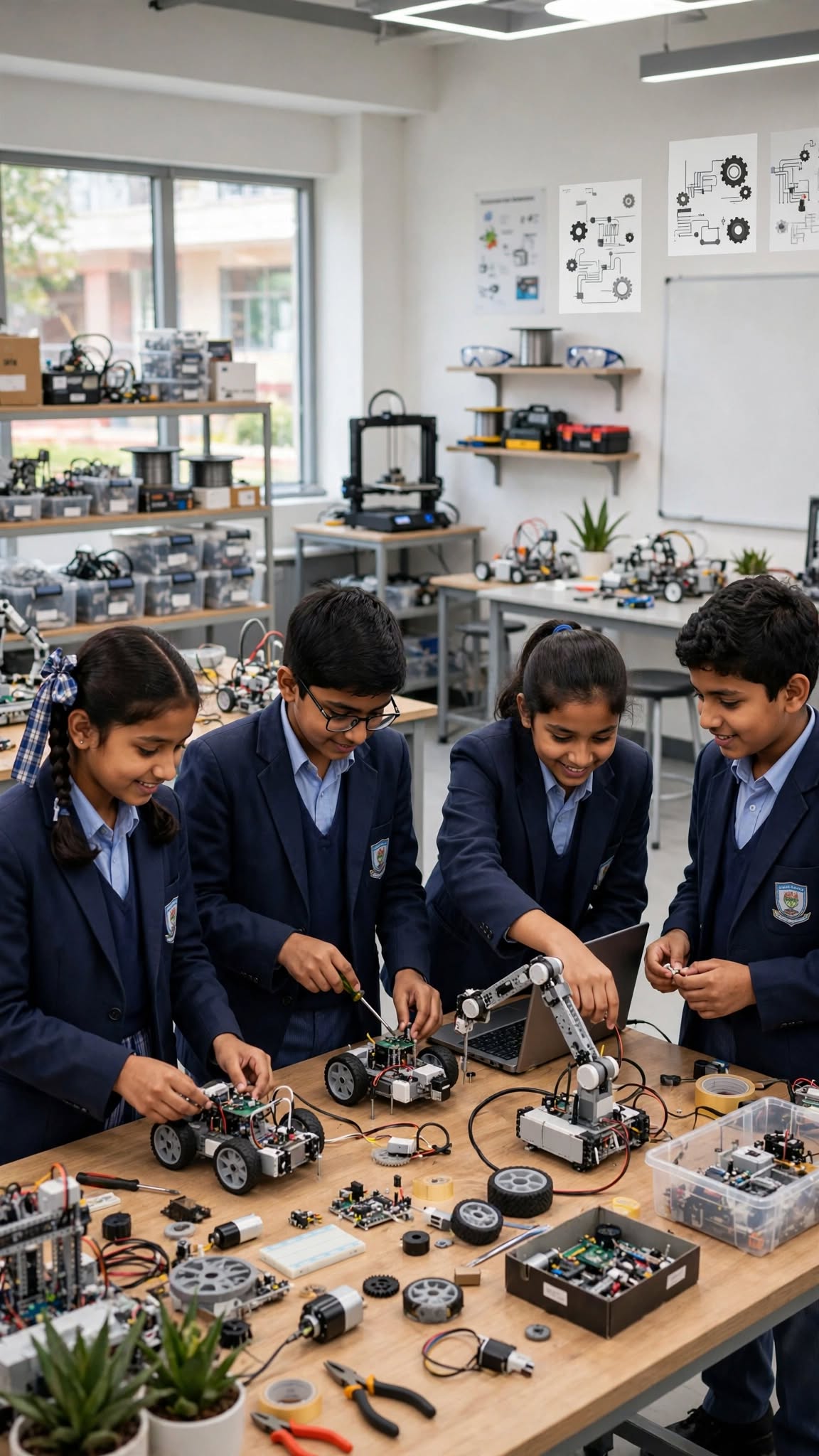
A robotics lab for schools that actually gets used runs differently. Students design a chassis, get it wrong, rebuild it. Write code that makes a motor stall, debug it until it doesn’t. Solve a problem the school actually has: a corridor that stays dark too long, a bin nobody sorts correctly, using a robot they built and understand end to end. The curriculum ties to what’s already on the timetable. Teachers walk in trained, not guessing. And the room stays busy well past the ribbon cutting.
Built to get used, not unboxed once and forgotten.
- Grades 1 through 12, each stage pitched at the right level of difficulty
- Mapped to CBSE, ICSE, and NEP 2020 so it fits the school year already planned
- Equipment chosen for the lesson, not for how it photographs
- Support that outlasts installation week, with someone to call when a build breaks
Support after setup
Someone to call when a build breaks
The lab solution
Everything a School Robotics Lab Needs to Actually Run
Dropping off boxes of hardware isn’t a robotics programme, it’s a delivery. A working school robotics lab needs four things moving together, not one impressive crate.
Curriculum that builds
Each term adds a genuinely new skill, rather than repeating last year’s build with a bigger price tag attached.
Hardware that earns its place
Sensors, controllers, and parts picked because a lesson actually needs them, not because a catalog pushed them.
Teachers who don’t need a rescue call
Real training before session one, and someone reachable when a wire won’t cooperate.
Projects with a point
Builds answering a question a student actually cares about, not a kit assembled exactly as pictured on the box.
Grades served
Different Builds for Different Years, on Purpose
An educational robotics lab shouldn’t hand a Class 3 student and a Class 11 student the same box with a different label. Each stage earns its own level of complexity.
Stage 1
Grades 1 to 5: Getting Hands Dirty
Levers, gears, and a first circuit that actually lights something up, building the instinct that machines can be understood, not just used.
Early BuildsSimple MachinesFirst Circuits
Stage 2
Grades 6 to 8: Logic Meets Motion
Block based programming paired with a robot that has to obey it, where getting the code wrong means watching the build fail in front of everyone, and fixing it.
Block CodingSensorsGuided Robotics
Stage 3
Grades 9 to 12: Building on Their Own Terms
Python, autonomous navigation, and open briefs with no single correct build, the stage where a student’s robot starts looking like their idea, not the manual’s.
PythonAutonomous SystemsIndependent Builds
Built on what schools already teach
A Robotics Lab That Sits Inside the Syllabus, Not Beside It
NEP 2020 asks Indian schools to teach through doing, not through another chapter read aloud. A robotics lab in schools works best when it’s stitched into that expectation directly, tied to CBSE and ICSE science, maths, and computing content already on the calendar, instead of competing with the timetable as an unrelated extra hour nobody quite has room for.
Why it exists
For the Student Who Wants to Fix It, Not Just Watch It Work
A robotics lab for school students earns its name the moment a student is chasing their own question, not copying a diagram. A robot that has to find its own way through a maze, using its own sensors, teaches something a robot wired exactly per the instruction sheet never will. Same components. Completely different lesson underneath.
The best projects come from something specific
- A rover mapping which classroom runs hottest by afternoon.
- A sorting arm built after three failed attempts.
- A line follower that only worked once the sensor got recalibrated for the third time.
None of that shows up on a highlight reel. All of it is where the actual learning happened.
Who is it for
Is a Robotics and Coding Lab for Schools Worth It Here?
Built for schools past the stage of wanting a single flashy demo day.
For Students
- Want to build something that has to actually work, not just look finished
- Curious about circuits, sensors, code, or how a machine decides what to do next
- After hands on learning that connects back to the subjects they’re already studying
- Fine with getting a build wrong a few times before it’s right
For Teachers
- Ready to run a school robotics lab without needing an engineering degree first
- Tired of writing lesson plans from a blank page every single week
- Wanting a real person to call, not a manual, when a build breaks mid class
- Comfortable letting a student struggle a bit before stepping in
For School Leaders
- Treating a robotics lab for schools as a multi year investment, not a one time purchase
- Wanting hardware chosen against actual outcomes, not a vendor’s biggest package
- Interested in what this could mean for STEM Enabled School (SES) recognition
- Looking for a partner who’s still answering calls a year after installation
Implementation and support
Getting From an Empty Room to a Working Lab
A robotics lab for schools doesn’t arrive finished in one truck. It gets built in stages.
Support doesn’t stop at handover. Parts wear out, projects age, and refresher sessions keep teachers current as the programme keeps moving.
- Decide what students should walk away able to do.Outcomes come before any equipment list.
- Look honestly at what’s already there.Space, tools, and teacher confidence, without flattering the current setup.
- Pick hardware the curriculum actually calls for.The lesson decides the kit, never the reverse.
- Get teachers comfortable before students show up.Both the tools and the art of not solving a problem for a stuck student.
- Start with one grade, not every grade at once.Prove it works small before betting the whole timetable on it.
Level up from here
The Lab Is Where It Starts, Not Where It Ends
Once builds are running smoothly, there’s usually somewhere further for a student to take it.
STEM Enabled School (SES) Recognition
A robotics lab can become the first rung toward a publicly verified SES standard, not a certificate any vendor can quietly print in house.
SES Silver SES Gold SES Platinum
STEM Competitions
Take a lab build straight into robotics, coding, and open innovation events like STEM Fiesta, where it gets tested against other schools’ work.
Robotics Coding Open Innovation
Young Scholars Research Programme
For a student whose robotics project has turned into an actual research question worth writing up properly.
Research Mentorship
School proof
What This Actually Looks Like Once It’s Running
Real, permissioned examples of student robotics projects, teacher feedback, and lab outcomes from confirmed Makers’ Muse implementations, with dates and context.
Student robotics project photo (with permission, date and school)
Teacher feedback or quote (with permission)
Lab outcome or demo-day highlight (with date and context)
Frequently Asked Questions
A defined sense of what students should be able to do by term’s end, hardware matched to that goal, teachers trained ahead of time, and a curriculum tied to lessons already being taught, not a kit ordered before any of that gets decided.
Usually not. Most schools convert an existing computer room or science lab with the right additions rather than constructing something from the ground up.
As early as Grade 1, with simple machines and basic circuits, growing into autonomous builds and independent projects by the senior years.
No. The training is designed for teachers starting from zero, covering both the hardware itself and how to guide a stuck student without just handing them the fix.
A workshop is a single afternoon that ends. A robotics lab for schools is a running programme, building skill term over term, with support that doesn’t disappear once the vendor leaves the building.
Not at all. Competitions are one path forward, not a requirement. Plenty of students get real value from the lab without ever entering an event.
The next step is yours
What’s the First Robot Your Students Build?
Pick a grade band to start with, line it up against what’s already being taught, and get a robotics lab for schools running before the term’s out.