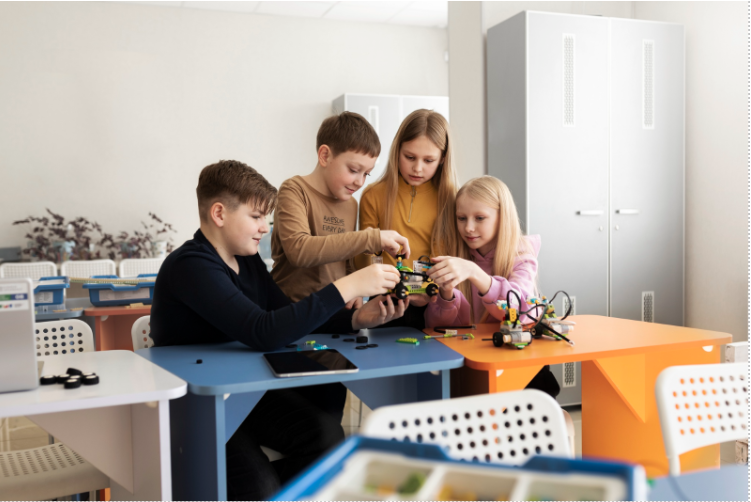


A school principal recently asked, fairly bluntly, whether buying a robotics kit basically covered “the AI thing” too. It doesn’t, not really, and the confusion is understandable. The two get lumped together constantly, in marketing, in news coverage, sometimes even in curriculum documents that should know better. AI vs robotics isn’t actually a rivalry, though. They’re different disciplines that happen to overlap a lot in practice, and understanding the difference between AI and robotics matters quite a bit when a school is deciding what to actually invest in.
What Each One Actually Means
Two separate questions get treated as one blurred concept constantly, so it’s worth pulling them apart properly.
- Artificial intelligence is software, full stop, no physical form needed anywhere. It learns patterns from data and uses them to predict or decide something. A recommendation algorithm humming away in the background, a chatbot, an image classifier sorting photos- none of it needs a body. It’s all just code.
- Robotics is the opposite half, the physical side, machines built to sense what’s around them and actually do something in response, using motors, sensors, actuators, whatever gets the job done mechanically. And here’s the bit that trips people up: a line-following robot, a robotic arm, a cart that swerves around obstacles- none of that requires AI at all. A huge amount of robotics runs on plain, pre-programmed logic. No learning happens anywhere in the loop.
So, body versus brain, roughly, is the cleanest way to think about robotics vs artificial intelligence. The robot is the body. AI, on the occasions it shows up, is one way of running the brain, though plenty of robots get by on far simpler logic instead. Most of the confusion around AI vs robotics comes down to exactly this mix-up, assuming every robot must be secretly running some AI underneath, when a lot of them just aren’t.
Where They Actually Overlap
This is where the confusion usually starts, and honestly, it’s a fair place to get confused. A robot that uses computer vision to recognise an object before picking it up is combining robotics and AI directly. A robot that navigates on its own without getting into trouble by means of using an advanced trained model is another example of the same process. In conclusion, the merged area is a wonderful one for the pupils to discover. However, it is important to point out that it is just a narrow scope of reality.
Core Differences at a Glance
AI | Robotics | |
What it is | Software that learns and predicts | Physical machines that sense and act |
Physical form | Not required | Core to the discipline |
Core skills | Python, data handling, statistics | Electronics, mechanics, embedded programming |
Typical tools | TensorFlow, PyTorch, Teachable Machine | Arduino, Micro:bit, motor and sensor kits |
Output | A prediction, classification, or decision | A physical action or movement |
Classroom Examples
An AI-only project might have students training a model to sort images of recyclable versus non-recyclable waste, entirely on a laptop, with no hardware involved beyond the computer itself. A project focused strictly on robotics could utilize a simple line-following robot, consisting of basic sensor technology and a simple control loop. There is no machine learning or predictive technologies incorporated.
Moving towards the more hybrid project idea, a robot could utilize a trained image classifier to organize physical objects on a mini conveyor belt. These combined builds tend to be the most memorable projects for students, mainly because they connect an abstract concept to something that physically moves in front of them.
Which Skills Each One Builds
- AI work typically strengthens the skill of statistical thinking, the ability to deal with messy data, and the ability to reason about probabilities and uncertainties.
- On the other hand, robotics work builds up the skills of physical troubleshooting, circuit understanding, and immense patience when a wire goes loose for the third time in one hour.
When to Choose AI, Robotics, or Both
If a Student’s Drawn to Data and Patterns
Start with AI. No physical build is needed, and if someone lights up over spreadsheets, statistics, or the “wait, what does this pattern actually mean” kind of question, that’s usually the better entry point than handing them a soldering iron.
If a Student Wants to Build Something They Can Hold
Robotics wins here, pretty clearly. Handling the wiring, fixing a loose connector, witnessing the operation of a machine as a result of your actions – this kind of tangible reward makes students feel more involved than simply staring at the code written on a computer.
If the School Can Support Both
Then aim for the overlap eventually, since that’s genuinely where most real-world work in this space ends up happening anyway. AI and robotics in education tend to work best treated as a progression rather than a forced either-or, robotics or basic coding first, AI concepts layered on once the fundamentals are solid.
Fitting This Into a School’s Curriculum
The introduction of AI and robotics in schools does not require separate departments. Robotics education starts in school early on, between Grades 6 and 8, where students learn about building and basic programming before getting into AI concepts in Grade 9.
Generally speaking, an education system that focuses on programming first and adds AI later has proven to be much more efficient than attempting to teach them both at once. Thinking through AI vs robotics for students this way, as a sequence rather than a single choice, tends to produce far better outcomes than picking one and ignoring the other entirely.
Schools weighing AI and robotics in schools as a combined offering usually find the sequencing question matters more than which one gets bought first.
Where Makers’ Muse Fits In
Rather than forcing a school to pick one lane, Makers’ Muse’s combined lab approach lets students move between AI and robotics work inside the same infrastructure, starting with whichever discipline suits a given class and building toward the overlap as skills develop.
A separate field that frequently overlaps with AI. Most robotics runs on straightforward pre-programmed logic, and AI is only one of several ways to make a robot behave intelligently.
Neither is inherently easier, though robotics tends to feel more immediately rewarding since progress is visible and physical, while AI progress often stays on a screen for longer before anything tangible shows up.
Not necessarily. A well-planned combined lab can support both, sharing infrastructure like computers and workspace while adding robotics-specific hardware alongside AI software tools.
A robot that uses a simple trained image classifier to sort objects, recognising color or shape before sorting them physically, is a popular and achievable first combined project for most secondary-level students.