
Makers' Muse presents
An AI Lab for Schools Built Around Real Student Work
Most rooms called an “AI lab” are a computer lab with a new sign on the door. Laptops. A projector. A coding subscription nobody customized for your students. That’s not what this is.
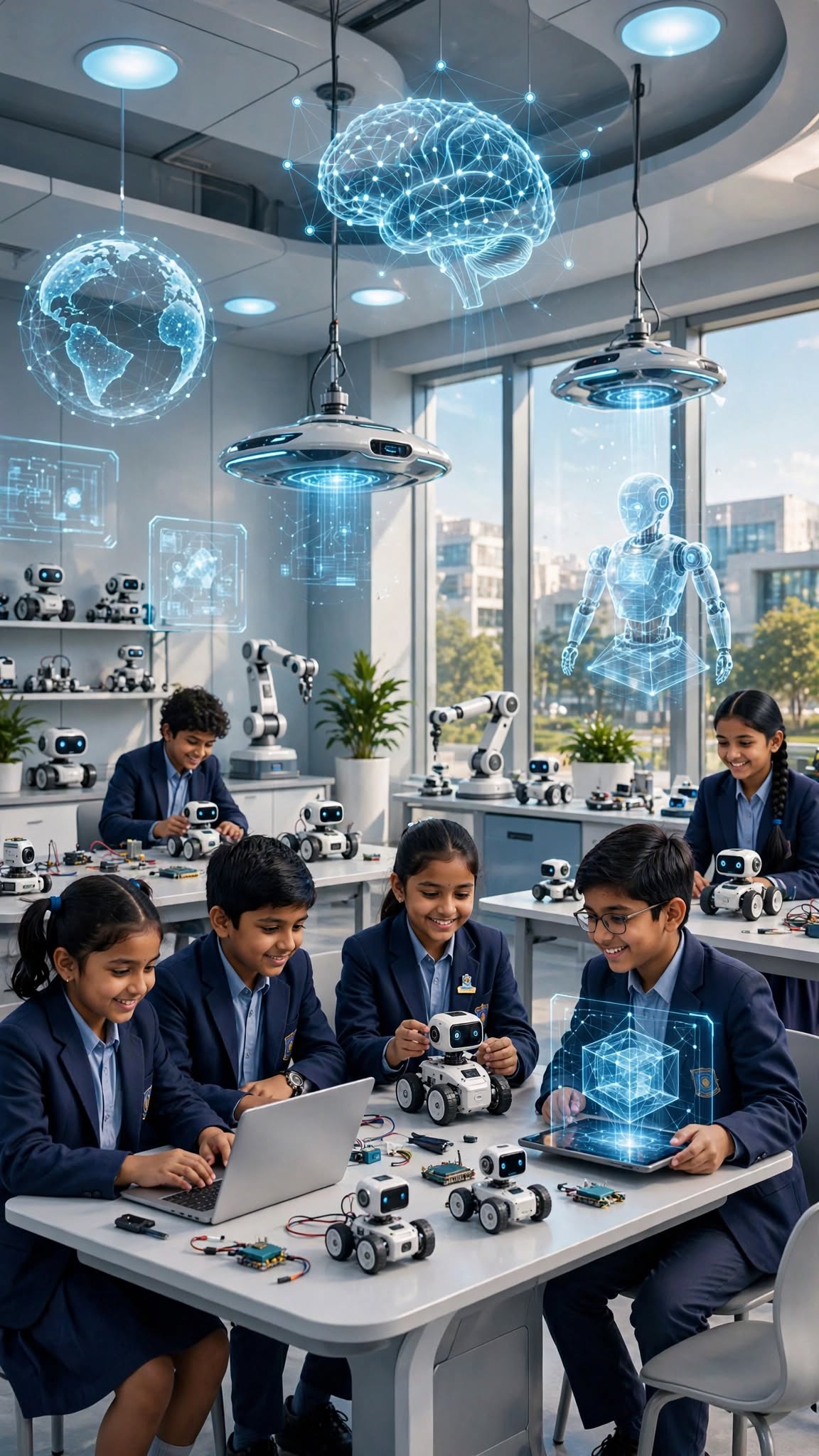
Makers’ Muse builds an AI lab for schools where students train models on real datasets, wire up sensors that actually respond, and build robots that navigate on their own logic, not a script someone else wrote. Every module maps to your existing curriculum, every teacher gets trained before day one, and every project ends in something a student can explain, not just demo.
This isn’t a computer lab with a new label. It’s where your students actually build AI.
- Grades 1 to 12 covered, with content scaled to each stage
- Curriculum aligned to CBSE, ICSE, and NEP 2020 frameworks
- Hardware and software chosen for the outcome, not the sales catalog
- Teacher training included, with support that continues after setup
Teachers trained first
Before the first student session
Built on what schools already teach
Your Curriculum, With an AI Lab Attached to It
CBSE introduced Artificial Intelligence as a formal skill subject from Class 6 onward. At the senior level, that means roughly 60 hands on lab sessions and 60 classroom sessions for Classes 9 and 10. NEP 2020 backs the same direction nationally: experiential, hands on learning as the standard, not the exception.
An AI education for schools programme should sit inside this structure, not beside it as a disconnected extra period competing for the same time and attention.
Choose your grade band
Three Stages. Zero Repeated Kits.
Content scales up with age, not just difficulty. No student repeats the same activity two years in a row at a higher price.
Stage 1
Grades 6 to 8: Foundations
Block based coding, foundational logic, and a first real look at how sensors and basic automation actually work.
Beginner FriendlyBlock CodingSensors
Stage 2
Grades 9 to 10: Applied Skills
Python, applied machine learning concepts, and small robotics builds tied to a real problem, aligned with the formal AI curriculum sessions schools already run at this stage.
PythonMachine LearningRobotics Builds
Stage 3
Grades 11 to 12: Independent Depth
Deeper AI and ML projects, real data driven investigations, and a path into independent research for students who are ready to go further.
Advanced MLData ProjectsResearch Pathway
Learning by building
Built for Students Who Want to Build, Not Just Watch
An AI lab for schools only earns the name when students are testing their own ideas, not assembling a kit exactly as instructed. A sensor kit used to answer “which corner of our garden dries out fastest” teaches something a kit built strictly per the manual never will. Same tool. Different question driving it.
Every module ends in a real artifact. The test isn’t whether it looks polished on demo day. It’s whether the student can explain why they built it that way.
Every module ends in a real artifact
- An image classifier trained on a dataset the student collected themselves.
- A robot navigating on live sensor feedback, not on a script someone else wrote.
- A data project analyzing something specific to the school’s own environment.
Who is it for
Is an AI Lab in Schools Right for Yours?
Built for schools that want more than a one day workshop and a certificate on the wall.
For Students
- Want to build a real AI or robotics project, not just watch a demonstration
- Curious about coding, machine learning, sensors, or automation
- Looking for hands on STEM learning that connects to what they study in class
- Comfortable working through a real problem, not a fixed worksheet answer
For Teachers
- Running sessions in a school AI lab without needing a technical background first
- Looking for a structured curriculum instead of building lesson plans from scratch
- Wanting ongoing troubleshooting support, not a one time training session
- Comfortable guiding a stuck student without solving the problem for them
For School Leaders
- Considering an artificial intelligence lab for schools as a curriculum upgrade, not a one off purchase
- Wanting equipment and modules chosen against real learning outcomes
- Interested in a path toward STEM Enabled School (SES) certification
- Looking for a partner who trains teachers and stays past installation day
What's included
Hardware and Software Chosen to Fit, Not Impress
Hardware
- Computers capable of running basic ML workloads
- Microcontroller kits for robotics builds
- Sensors for real world data collection
Software
- Accessible, well documented tools
- No lock in to a single closed vendor ecosystem once the contract ends
Curriculum and Training
- Modules mapped to CBSE, ICSE, and NEP 2020 frameworks
- Teacher training before the first student session
- Ongoing troubleshooting support as the programme runs
Level up from here
An AI Lab Is the Starting Point, Not the Ceiling
Setting up an AI learning lab is one piece of a bigger picture. Once students are building confidently, Makers’ Muse offers paths to take the work further.
STEM Enabled School (SES) Certification
Turn your AI lab into the foundation for a public, verified STEM standard, not a private badge any vendor can hand out.
SES SilverSES GoldSES Platinum
Young Scholars Research Programme
For students ready to go past a classroom project into an actual mentored research paper.
Research Mentorship
STEM Competitions
Send lab projects straight into robotics, coding, and open innovation competitions like STEM Fiesta.
RoboticsCodingOpen Innovation
What's at stake
From SES Silver to SES Platinum
An AI and robotics lab for schools is usually the foundation a school needs before climbing toward STEM Enabled School status. Every tier is verified, not self declared.
| Tier | What It Takes | What You Get |
|---|---|---|
| SES SilverFoundation | Programme live, teachers certified, first parent showcase done | Certificate, badge, listing on the public SES map |
| SES GoldResearch Active | Silver + active student research, first published paper, competition entry | Badge upgrade, SES Principal Circle invitation |
| SES PlatinumExcellence | Gold + 3+ published papers, national competition placement, live projects | Platinum badge, Annual Showcase, senior Circle membership |
Glimpse
A Look Inside Our AI Labs
Real, permissioned examples of student projects, teacher feedback, and lab outcomes from confirmed Makers’ Muse implementations, with dates and context.
Student project photo (with permission, date and school)
Teacher feedback or quote (with permission)
Lab outcome or demo-day highlight (with date and context)
Get started
How Setup Actually Works
Support continues after installation: maintenance, updated project libraries, and refresher training as the programme grows.
- Define outcomes.What should students understand, build, and demonstrate by term’s end?
- Audit what exists.Space, equipment, and teacher readiness, assessed honestly.
- Choose tools that match the outcome.Not the biggest catalog a vendor can offer.
- Train teachers before students arrive.Technical skills and teaching approach, together.
- Pilot small. Scale once it’s working.Full rollout comes after a working pilot, not before.
Frequently Asked Questions
Clear learning outcomes, grade appropriate hardware and software, trained teachers, and a curriculum that connects to what’s already being taught, not equipment bought ahead of a plan.
An existing computer lab can usually be upgraded with the right hardware and modules. A dedicated new space isn’t a requirement to start a school AI lab.
Makers’ Muse AI labs support Grades 1–12 with age-appropriate activities, from basic AI concepts to advanced coding, robotics, and machine learning projects.
No. Training covers the tools and the teaching approach together, backed by ongoing support once teachers are running sessions independently.
A coding class teaches programming on its own. An AI lab in schools combines coding, robotics, and real data work into projects tied to curriculum outcomes.
Pricing models vary, upfront hardware cost versus a subscription or per student model. Get a specific quote in writing before committing to either.
The next step is yours
What Will Your Students Build First?
Pick a starting grade band, map it to your existing curriculum, and bring an AI lab for schools into your building this term.