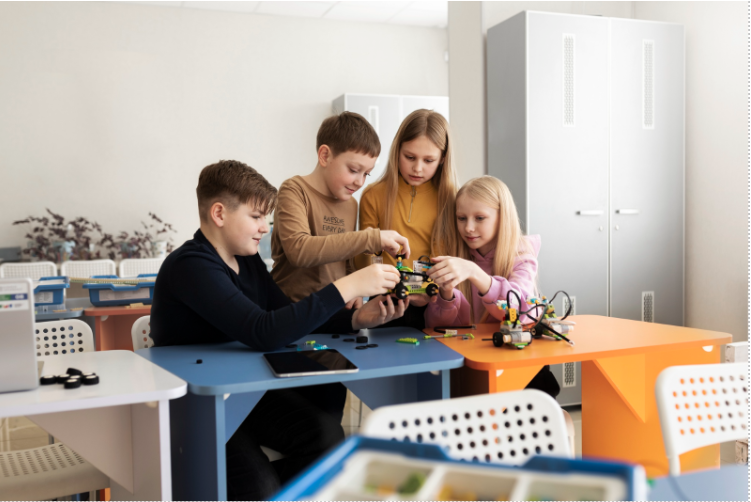


Most robotics programmes that fizzle out do so quietly. Nobody cancels them. A club meets less often, a kit stays boxed after the enthusiastic teacher moves on, and by year two the whole thing is a line in the prospectus that nobody can quite explain. The pattern is avoidable, and it usually comes down to how the start was handled.
Anyone asking how to introduce robotics in schools should know that making robotics education in schools last has far less to do with what gets bought and far more to do with the decisions made before anything arrives.
Before You Start with Robotics Education in Schools
Set Goals You Can Actually Check
“Expose students to robotics” sounds fine and tells you nothing. A goal worth having is one you can look at in twelve months and answer with a plain yes or no. A few examples of the right size:
- Every Grade 7 student completes one working sensor-based build by the end of the year
- Three teachers can run a robotics session on their own, with no outside help
- At least one project per grade band gets shown to parents at the term showcase
Vague goals make every later choice harder, because nothing exists to test the choices against.
Pick the Grades to Begin With
Launching across every grade at once is the classic overreach. It stretches a small pool of trained staff far too thin. One or two grade bands gives everyone room to learn, and most schools find middle school the friendliest entry point, since students are old enough for real building but not yet buried in board-exam pressure.
Find the Timetable Slot
This is the unglamorous decision that quietly kills more programmes than any funding gap. Without a fixed slot, robotics competes with everything else and loses whenever something urgent comes up. Three common homes for it:
- Inside an existing subject period, usually science or computing
- A weekly activity block that every student in the chosen grade attends
- An optional club, which is easiest to start but hardest to keep consistent
Pick one early, then protect that slot the way you’d protect a core subject.
Building the Programme
Get Teachers Ready First
A teacher walking into a robotics session with a week’s head start on the students is a shaky foundation for teaching robotics in schools. Training has to come before launch, match what that teacher will actually teach, and leave time to practise. Some things worth checking before anyone stands in front of a class:
- Can they explain what the students are building without reading from notes?
- Have they seen a build fail and worked out why?
- Do they know who to ask when they get stuck?
A primary teacher doesn’t need to understand microcontroller code. They do need to stay calm when a build goes wrong in front of thirty children, because it will.
Fold It Into Existing Coursework
Robotics survives longest when it borrows from subjects already on the timetable instead of competing with them.
Subject | What robotics adds |
Physics | Force, motion and circuits become the reason a build works or fails |
Maths | Measurement, ratios and coordinates get real use |
Computer science | Code students already write gets a physical result |
Framed this way, robotics learning in schools reinforces the core timetable instead of taking hours from it, which makes it far easier to defend when budgets or schedules tighten.
Choose a Lab Model or a Classroom Model
Schools generally end up with one of two arrangements, and each fits a different situation.
| Dedicated lab model | Classroom model |
How it runs | Students move to a fixed robotics room | Materials travel to regular classrooms |
Works best when | There is spare room and a named person to run it | Space is tight, or teachers share resources |
Main risk | The room sits idle outside scheduled slots | Setup and pack-down eat lesson time |
Scales by | Adding sessions in the same space | Adding portable kits and trained staff |
Neither is better across the board. Smaller schools often do well with the classroom model, while larger ones with a committed coordinator can get more from a fixed room.
Plan How Projects Progress
Projects should get harder on purpose, not by accident.
Stage | What students do |
Early | Get something to move at all |
Middle | Add a sensor so the build reacts to its surroundings |
Later | Combine sensing with decisions |
Advanced | Choose their own problem and design a solution |
The leap that trips most programs is the one from following instructions to designing a product. Take pains with that transition since it does not occur with any degree of regularity.
Running and Sustaining It
Assess What Students Can Do
A brief demonstration of the finished project combined with an explanation of at least one of the decisions made, and one problem experienced in doing it provides much more information than a vocabulary test. It also rewards the habits robotics is meant to build: patience, testing and honest reflection.
Roll It Out in Stages
Term | Focus |
Term 1 | Teacher preparation, timetable slot confirmed, one grade band starts |
Term 2 | First projects finished, feedback collected from staff and students |
Term 3 | Adjustments made, second grade band added if the first is holding up |
A staged approach to robotics implementation in schools lets problems surface while they’re still small and cheap to fix.
Measure Whether It’s Working
Measurement doesn’t need a dashboard. Three signals cover most of it:
- Teachers feel more confident than they did at the start
- Students finished what they began
- The timetable slot is still intact, not quietly eaten by something else
If all three look healthy after a year, the programme is doing its job.
Where Makers’ Muse Fits In
Makers’ Muse works with schools through this same sequence, from goal-setting and teacher training to project progression and measurement, so that a robotics program for schools is built as one connected effort rather than a set of separate purchases.
FAQs
For anyone working out how to introduce robotics in schools, expect a term to prepare properly, covering teacher training and the timetable, and a full year to run and evaluate robotics education in schools fairly.
Almost never. One or two grade bands come first in a robotics program for schools, then expand once the early group has settled.
Not necessarily. Many schools train existing science or computing teachers, which also keeps the subject connected to the rest of the timetable.
Skipping the planning and going straight to purchasing. Without goals, trained staff and a protected slot, even good materials tend to end up unused.