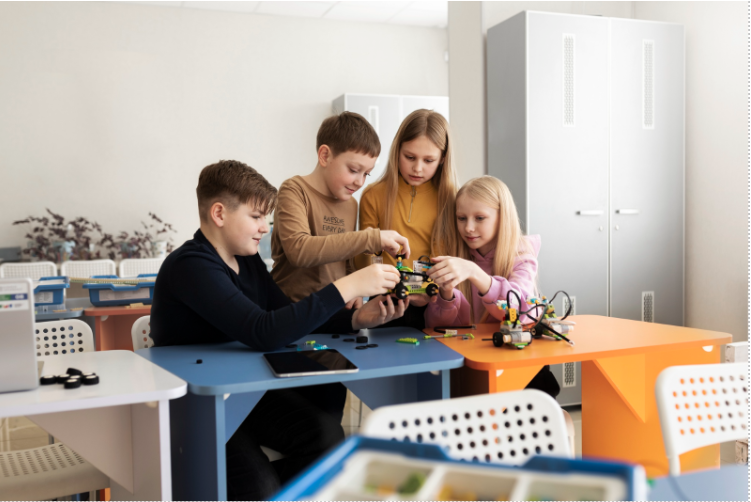


Digital technologies are shaping how students learn, communicate and solve problems, and that’s pushing computational thinking education further into the school curriculum. The Central Board of Secondary Education (CBSE) and IIT Gandhinagar’s Centre for Creative Learning have introduced a new season of the 3030 Eklavya programme, built around computational thinking, artificial intelligence and STEM.
The programme uses everyday objects and hands-on activities to introduce concepts that can otherwise seem technically dense, as part of CBSE’s wider push on AI literacy and computational thinking education in schools.
Making computational thinking accessible
Computational thinking education isn’t the same as learning to write programmes. It’s about breaking a complex problem into smaller parts, spotting patterns, working through logical steps, and asking how a solution could be improved. None of that requires students to start with an advanced programming language; everyday objects work fine for demonstrating sequencing, classification, patterns and logical reasoning.
That’s what makes computational thinking education less intimidating for students meeting these ideas for the first time. Rather than presenting technology as a specialised field, teachers can introduce the ideas underneath it through situations students already recognise. The 3030 Eklavya programme runs on exactly this principle, using ordinary materials to demonstrate AI, machine learning, computational thinking and STEM concepts.
Connecting AI with everyday learning
Younger learners often picture AI as something distant: sophisticated software, automated systems, specialised technology well outside their reach. School coding education and AI learning for students close that gap by connecting the subject to examples students can actually follow, such as how machines recognise patterns, process information or make predictions.
These activities show students that AI systems run on data, instructions and computational processes, which sets up more advanced computational thinking education later. The goal of AI learning for students isn’t to turn every student into a programmer. It’s to help them understand the technology around them and think critically about how it’s used.
Developing problem-solving abilities
Problem-solving sits at the centre of both computational thinking education and STEM technology education. Students need practice approaching a problem systematically instead of jumping straight to an answer. A classroom activity might ask learners to identify a challenge, break it into smaller components, and build a sequence of actions, then test the approach and adjust it if the result doesn’t work.
That process mirrors how computer scientists and engineers actually work, and it carries over into math, science and everyday decision-making. Repeated practice makes complex problems feel less intimidating and loosens students’ dependence on memorised procedures.
Encouraging hands-on AI learning
Hands-on AI learning turns abstract ideas into something students can actually see. Manipulating objects, observing patterns, testing a simple system: these connect theory to a visible outcome. The 3030 Eklavya initiative leans on this by using everyday materials as learning tools, which shows that meaningful hands-on AI learning doesn’t require a fully equipped lab.
That matters most for schools with limited access to advanced technology. Teachers can start with simple activities and build up to more complex ones over time, and hands-on learning has the added benefit of giving students room to make mistakes and figure out what went wrong.
Strengthening digital literacy in schools
Digital literacy in schools now covers more than operating a computer. Students need to understand how digital systems work, how information gets processed, and how emerging technologies affect society more broadly. AI literacy fits into that picture: students learn to question what an AI system produces and recognise that the technology can get things wrong.
That extends to data, privacy, bias and responsible technology use, ideas best introduced alongside practical activities rather than as a separate lecture. Digital literacy in schools matters because familiarity with technology doesn’t automatically mean a student understands how it works or how it should be used, and closing that gap is exactly what this kind of teaching is for.
Supporting teachers alongside students
Teachers carry the weight of introducing new technology into a classroom, and they need a solid grasp of the concepts and workable classroom strategies before students can benefit. The CBSE-IIT Gandhinagar initiative is built for both groups: it gives educators a structured way to engage with computational thinking education, AI and STEM concepts through practical activities.
When teachers understand the reasoning behind an activity, they can adapt it across subjects and student abilities, which helps computational thinking education become part of wider learning instead of sitting off to the side as an isolated topic.
Moving beyond coding education
School coding education often gets framed as the centrepiece of digital learning, but computational thinking education reaches further than programming. A student can build computational thinking while solving a science problem, organising information or designing a process, with coding arriving later as one tool among several for expressing those ideas.
That distinction opens the subject up. Students who don’t picture themselves as programmers can still develop real computational skills through problem-solving and logical reasoning, and those foundations carry forward into coding, robotics, data science and AI, well beyond what school coding education alone would cover.
Linking STEM with creativity
Technology education and creativity aren’t opposites. Designing a solution usually means imagining several possibilities and picking the one that fits the problem best. Hands-on STEM technology education puts logical thinking and creativity in the same room, letting students experiment with different designs and compare results.
Working with everyday materials sharpens this further, since students have to think creatively about how an ordinary object can stand in for a more complex idea. It’s a useful reminder that innovation often starts with a simple question and some experimentation.
Building future-ready learning
Students will keep running into automated systems in education, work and daily life as AI becomes more common, so schools have a role in helping them understand these technologies, not just use them. Future-ready education combines technical awareness with critical thinking, communication and problem-solving, teaching students to use technology while staying aware of its limits.
Computational thinking education builds the structured reasoning that underpins this, teaching students to approach problems systematically. AI learning for students then builds on that foundation, helping them understand how intelligent systems process information and produce outputs.
Creating accessible STEM technology education
One of the more useful features of the 3030 Eklavya approach is its reliance on familiar materials, which shows that STEM technology education doesn’t need to start with expensive equipment. Simple resources can demonstrate patterns, algorithms, logic and scientific principles, with more advanced tools introduced once students have built up confidence.
That keeps STEM technology education accessible across very different classroom settings, and it reinforces a simple idea: curiosity and questioning are a fine place to start.
Preparing students for emerging technologies
Students entering higher education and future workplaces will run into technologies that keep changing, and schools can’t predict every tool learners will eventually use. What schools can do is build transferable abilities: computational thinking, logical reasoning, problem-solving and critical evaluation stay useful even as the specific technology shifts underneath them.
AI learning for students needs to focus on the principles behind the technology, not just the tools in front of students right now. That’s what lets learners adapt instead of depending on one particular platform or application, and it’s where computational thinking education earns its keep long after a specific app or tool goes out of date.
FAQs
It teaches students to approach problems through logical steps, pattern recognition, decomposition and systematic reasoning. It doesn’t necessarily require programming and can be introduced through everyday activities.
AI shows up throughout everyday technology now, which makes basic AI literacy useful. School learning helps students understand how AI systems work, evaluate their outputs and think through responsible uses of the technology.
By starting with simple activities using everyday objects. Pattern recognition, logical sequences, classification and problem-solving exercises can introduce computational thinking education before students move toward specialised digital tools.
It helps students break problems into manageable parts, identify patterns and build logical solutions, skills that carry over into science, math, engineering, coding and technology.
Teachers help students make sense of technology within an educational context: guiding activities, explaining concepts, encouraging critical thinking, and helping learners think through the responsible use of AI.