

A counselor we spoke with put it bluntly: research does not get anyone in anywhere on its own. Nothing does. So what does research-led college admissions for school students actually mean, if it is not a golden ticket? Carefully done and documented independent work enhances the way an application comes across because it allows people to have an objective and verifiable basis for evaluation, in addition to grades, classes, recommendations, and essays. It doesn’t substitute for any of these activities. It does not guarantee an outcome at any particular institution. If someone is telling you otherwise, they are selling you something.
The intention of this guide for research-led college admissions for school students is to outline this distinction successfully for the benefit of school students, parents, school counselors, and mentors trying to figure out whether research represents a good investment of time. Throughout the guide, we pay special attention to the way systems like Common App and UCAS present the information they require from the applicants and suggest a number of questions about a research claim that can be asked by both an admissions officer and a parent who demonstrates reasonable scepticism.
What Research-Led College Admissions for School Students Means
Research-led college admissions for school students describes an approach where sustained, independent investigation becomes part of the evidence a student brings to an application, not a substitute for the rest of it. Research-led college admissions for school students still need the grades, the course rigor, and the recommendations that any competitive application requires regardless. Research adds a layer of demonstrated intellectual engagement on top of that foundation. It does not sit in for it.
What this does not mean matters just as much. It does not mean a published paper guarantees a seat at a particular university. It does not mean every field benefits equally; an application to a fine arts programme is not made stronger by an unrelated physics paper sitting in the activities list. And it does not mean older, pricier, or more prestigious-sounding research programmes produce stronger evidence than a well-documented, honestly reported project a student ran independently or through their own school. Every claim in this guide gets checked against one plain question: what can actually be verified, and what does that verification show once someone looks?
Doing Research to Learn vs Doing Research to Decorate an Application
There’s a real gap between a student who picks up research because a question genuinely bothers them, and a student who adds a research line to their activity list because it looks good next to debate club and a sports captaincy. Readers who work through thousands of applications a year develop a fairly reliable ear for the difference, and it usually shows up in specificity, not in enthusiasm. A student researching to learn can tell you what confused them, what they tried that failed outright, and what they’d chase next if given another six months. A student who added it as decoration can usually only tell you the title and the outcome.
That gap matters for everything below, because this research-led college admissions for school students guide assumes the first kind of engagement throughout. Genuine, sustained work happens to produce excellent application material as a side effect, almost by accident. Research pursued purely as application material tends to produce thin, easily questioned material instead, precisely because the depth that makes it convincing was never actually built in the first place. It’s the difference between student research for college admissions that holds up under a follow-up question and student research for college admissions that falls apart the moment someone asks a second one.
Research as One Part of a Holistic Application
Picture the application as several inputs a reader weighs against each other, not a single credential competing on its own. Grades and course rigor establish whether a student can handle the academic load a programme actually demands. Recommendations bring in an outside, credentialed view of the student’s habits and character. Essays let a student explain, in their own words, how their experiences connect to where they’re headed. Activities, research included, show how a student spends time outside class and what they care enough about to pursue without anyone forcing the issue. The context, which refers to the resources and opportunities actually available to a student, determines the interpretation of everything that was mentioned above.
A research portfolio intended for applying to university takes on maximum meaning when proving the image that the rest of the application already conveys: a student with grades, recommendations, and essays indicating curiosity now additionally confirmed by the project that demonstrates the student’s curiosity in practice. No research can be successfully interpreted by itself, as it will send a message of a problem student without any link to the relevant coursework qualifications or essays with no reference to the research.
What Admissions Readers Can Verify
This is the part most guides skip past, and it’s arguably the most important section here. Not all the entries listed on a resume can be verified in the same way, and as a rule, the entries that can be verified are way more useful than those entries which only seem impressive at first glance.
A professional resume reviewer can basically find out,
- what the actual research question was
- what the methodology was
- when and how long the work was done
- what the student’s contribution was (in case there was a mentor or group involved)
- what kind of an artifact was produced, meaning the actual manuscript/prototype/data set behind the work
- proof that the analysis was done rather than a conclusion was reached on faith
- proof that the work has undergone revision during the writing process,
- public output of the work, such as presentation at school, participation in some competition, etc.
What’s much harder to check, and what a sceptical reader tends to discount fast, is anything vague. Impact statements with no supporting detail behind them. Inflated titles or roles that don’t line up with the actual scope of a contribution. Claims of publication in venues nobody can locate through an ordinary search. Results presented with zero acknowledgement of limitations, which is itself suspicious, since real research almost never comes out clean.
Why a Publication or DOI Is Not Automatically Stronger Evidence
A lot of families new to this space assume a published paper with a DOI automatically beats a well-documented, unpublished project. That’s not true, and treating it as true pushes some students toward journals that will publish nearly anything for a fee, which ends up doing more harm than good.
A DOI, short for Digital Object Identifier, confirms a paper has been registered with an agency such as Crossref and has a permanent, citable record. That’s genuinely useful. The fact that a paper has been published, ideally after going through peer review, does not necessarily guarantee the quality of the peer review process itself, given that different journals have different standards.
Furthermore, while some venues charge large amounts to allow publication without any worthy reviews, an academically rigorous paper, properly prepared at the school level with a specific research question, an appropriate method, correct analysis, and a proper understanding of its weaknesses, may be better than a paper published in a low-quality journal just to have at least one publication to show at colleges.
The Committee on Publication Ethics, known as COPE, and the Directory of Open Access Journals, known as DOAJ, both publish guidance meant to help people tell legitimate academic publishing apart from venues built mainly to collect fees. Anyone evaluating a specific journal, whether that’s a student, a parent, or a counselor, should run it against that kind of guidance before treating a publication credential as automatically strong.
Describing Independent Work, Team Contributions, and Mentor Support Accurately
The way a student portrays themselves is just as vital as what they process. If a student exaggerates their involvement in a project, claiming the project was independent while it was mainly guided by a mentor, or trying to present their support role as a leadership one, a huge gap is formed between the assertion and the actual proof. Readers who pay attention to this incongruity are more often than not able to detect it, even when students think they will not be caught. There usually follows a dialogue in which the writers’ exaggeration is pointed out directly.
One could make good use of a contribution statement that provides a student with a precise description of what they did during this or that project, what role was played by a teacher, mentor, or colleague of theirs. There is no need for this statement to be presented word for word in one’s application, but it helps make sure that the writer has accurate data for essays, activity descriptions, and interviews. Accuracy protects the student here, not the other way around. A claim that can’t survive a direct follow-up question does more damage to an application than a modestly stated, accurate contribution ever would.
A Four Stage Pathway: Explore, Deepen, Document, Communicate
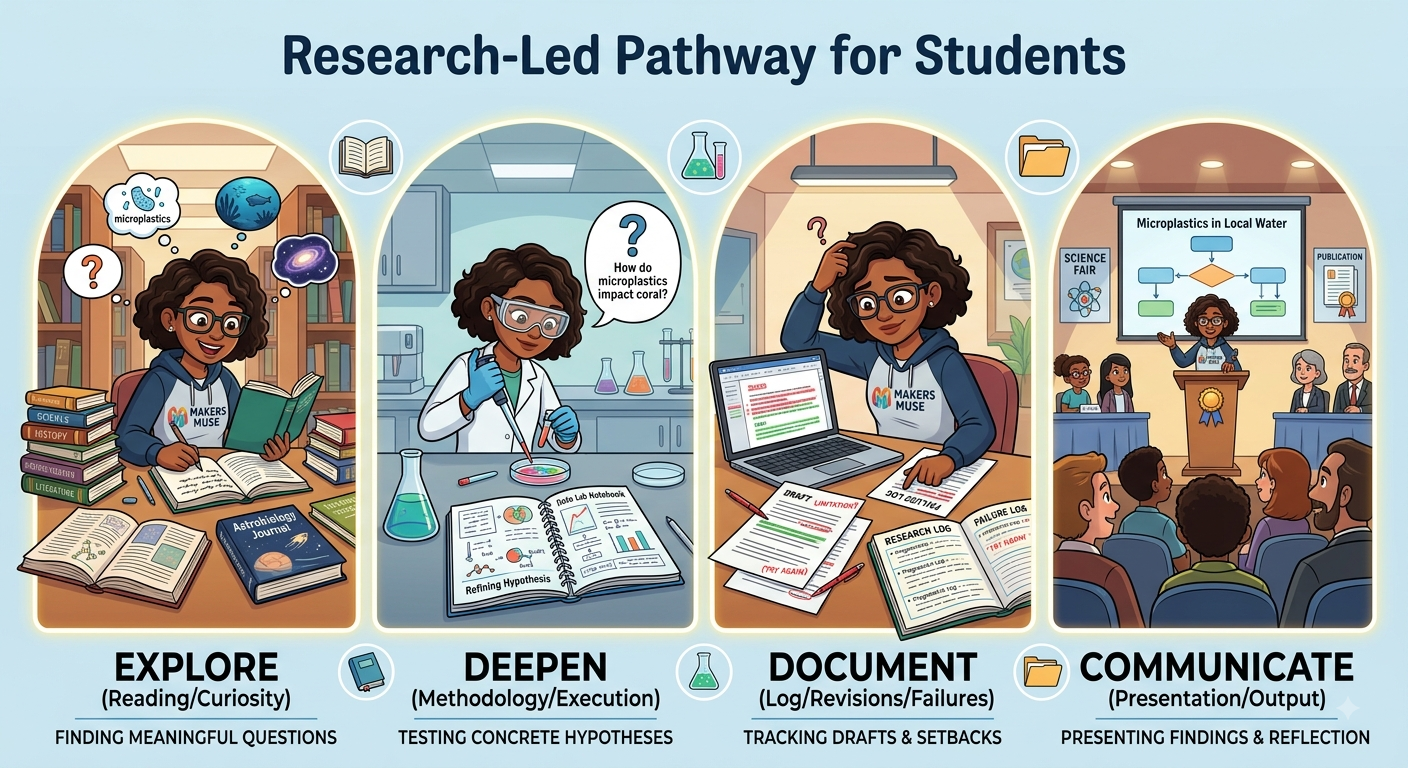
Rather than treating research as one big event, it helps to think of it as four connected stages, each producing its own flavor of evidence.
- Explore. A student notices something worth chasing and spends time reading around it, without committing to a full project just yet. What comes out of this stage is informal: notes, questions, an early reading list. It tends to happen earliest, often somewhere in Class 8 through 10.
- Deepen. The student narrows down to a specific, answerable question and starts a real investigation, choosing a method, collecting information, beginning analysis. A good chunk of STEM projects in college applications take shape right here, the moment a broad interest becomes one concrete, testable question instead of a vague area of curiosity. The evidence at this point gets sharper: a defined question, a documented method, early data or findings.
- Document. The work gets written up properly, following a recognizable research structure, and the student keeps a record of the process itself, not just the final result: drafts, revisions, an honest account of what didn’t work. The evidence here is the manuscript, plus the research log sitting behind it.
- Communicate. The student presents the work somewhere suited to its actual audience, a school symposium, a competition, a journal submission where that’s genuinely appropriate, or simply a strong description folded into an application. Here the evidence is the public output itself, plus the student’s own reflection on what the work actually taught them.
A student doesn’t need to reach communicate for research to count for something. Plenty of high school research experience stalls at deepening and still represents genuine engagement, still produces material worth including, described honestly for exactly what it is rather than dressed up as more.
How Common App and UCAS Ask Students to Connect Activities to Interests
Two of the largest application systems show, side by side, how differently structured evidence gets requested, and why a generic paragraph about a research project rarely fits either format cleanly without real adaptation.
- Common App’s activities section allows up to ten entries, each capped at a short position title, an organization name, and a 150-character description of what the student actually did and accomplished. That tight space rewards specificity over breadth every time. A precise, concrete line about a research contribution reads better than a sweeping claim about impact that doesn’t fit the format anyway, no matter how it’s phrased.
- UCAS, used across most UK undergraduate applications, restructured its personal statement starting with the 2026 entry cycle. Instead of one free-form essay, applicants now answer three separate, structured questions covering their motivation for the course, how their academic preparation connects to it, and what they’ve done outside the classroom that relates to their interest, all within a combined 4,000-character limit and a minimum length per section. A research project described here needs to connect explicitly to course fit. Simply listing it as an achievement won’t do much on its own.
Application systems elsewhere, and individual universities inside both the US and UK systems, vary further still. None of this should read as one universal process. Research-led college admissions for school students look genuinely different depending on the country and the institution. Common App and UCAS are used here as illustrations of how structured evidence gets requested, not as a standard every university follows. Always check the current, specific requirements of each institution a student is actually applying to. There information given here may not be completely accurate and may change with time.
Supplementary Research Material: Check Before You Send It
Some universities and specific programmes let applicants submit material beyond the standard application: a research abstract, a portfolio, a paper. Others explicitly don’t, or restrict the option to particular courses like art, music, or certain research-heavy programmes. There’s no consistent rule running across institutions here.
Before attaching any research supplement, a student should check the current admissions policy of that specific university directly, since sending unsolicited material to an institution that doesn’t accept it can, at some universities, actually work against an application instead of for it. Where a supplement genuinely is welcomed, it should be the strongest, most representative piece of work available, with a short note explaining the student’s specific role, not the longest or most technically dense document they happen to have on hand.
Red Flags in Research-Led College Admissions for School Students
A handful of patterns keep showing up in how research-led college admissions for school students gets marketed to families, and anyone evaluating a research programme, including this one, should check for them directly rather than taking a website’s word for it.
Pay-to-publish journals with minimal or no real peer review, often spotted by unusually fast turnaround times paired with fees far out of proportion to any genuine editorial work being done. Inflated titles that don’t match a student’s actual scope of contribution, calling a supporting role “lead researcher” being the classic version.
Ghostwritten papers, where a mentor or a paid service produces the actual content and the student’s name gets added afterwards, which is both an authenticity problem and, at most institutions, a straightforward violation of academic integrity policy if it’s ever discovered. Invented or exaggerated impact claims that can’t be traced back to anything real. And marketing language promising or implying guaranteed admission, a scholarship, or a specific outcome in exchange for a paid research programme, something no legitimate provider can honestly offer, since admissions decisions are made by universities, never by a third-party programme sitting outside that process.
Myth vs. Reality
Myth | Reality |
A published paper guarantees admission | No single credential guarantees admission at any competitive institution |
A DOI proves the research is high quality | A DOI confirms registration, not the rigor of peer review behind it |
More publications always look better | One well-documented, honestly described project often reads stronger than several thin ones |
Mentor involvement weakens a project | Mentor involvement is expected and fine, as long as the student’s actual role is described accurately |
Research only matters for STEM applicants | Research-led evidence applies across fields, including humanities and social science, when the topic and course genuinely connect |
A prestigious-sounding programme name is proof of quality | Programme quality shows up in documented process and mentor accountability, not in branding |
A Verification Checklist for Parents and Counselors
Before treating a student’s research credential as strong evidence, it’s worth checking the following directly with the student, rather than taking a polished summary at face value.
- Can the student explain the research question without reading from something prepared in advance?
- Can they describe the method well enough that someone else could actually follow it?
- Can they name at least one real limitation or weakness in their own work, unprompted?
- Does their described role match what a mentor or teacher would independently confirm if asked separately?
- If a paper was published, does the journal or platform appear in a legitimate index, and does a basic search confirm it exists and is actually reachable?
- Does the student have a research log or a set of drafts showing the work developed over real time, rather than appearing all at once, fully formed?
- Does the claimed research connect to the rest of the application, the courses taken, the recommendation letters, the personal statement, or does it sit off on its own, disconnected from everything else?
A student who answers most of these clearly has evidence worth including as is. A student who stumbles on several of them may still have done something valuable, but the description of it needs to be scaled back to match what can actually be supported under questioning.
Families deciding whether to pursue structured research support should start by being honest about readiness and evidence, not by assuming any programme, this one included, can promise an admissions outcome, because none of them honestly can. Makers’ Muse offers a research readiness and evidence checklist that mirrors the verification questions covered throughout this guide, meant to help families assess fit before any conversation about mentorship even begins. Makers’ Muse positions itself as a structured learning partner supporting the research process described here, not as a guarantor of any particular admissions result, and admissions evidence for students works best when families understand that distinction going in.
To review the readiness and evidence checklist on research-led college admissions for school students, request a consultation today.