 Written by
Laiba Arif
·
Written by
Laiba Arif
·
STEM Learning - How to Help Your Child Choose the Perfect Innovation Project: 3 Questions That Always Work
Most students do not struggle with learning concepts. They struggle with choosing what to build.
Ask any child in a robotics or STEM workshop, and you will often hear the same hesitation:
“I have ideas, but I don’t know which project to pick.”
This is where innovation education often breaks down. Without the right direction, students either pick something too simple, too complex, or not personally interesting. The result is a project that feels like an assignment instead of an experience.
Makers’ Muse Live Projects and Workshops are designed to solve exactly this gap. Instead of random project selection, students are guided through structured thinking, hands-on experimentation, and real-world problem solving across robotics, coding, electronics, IoT, AI, and design-based builds.
But even within such a structured ecosystem, the right questions can help a child move from confusion to clarity. Here are 3 powerful questions that always help children choose the perfect innovation project.
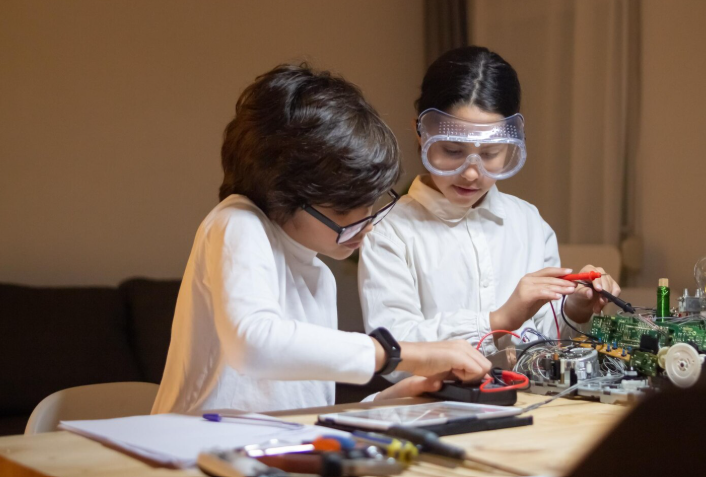
Question 1: “What problem do you see around you that you wish you could fix?”
Most children think innovation starts with tools. In reality, it starts with observation.
Makers’ Muse Live Projects are built around real-world contextual learning, where students are encouraged to connect STEM concepts with everyday life. This question helps them shift focus from “what can I build” to “what problem can I solve.”
This aligns directly with the Makers’ Muse approach of:
- Authentic contextualization
- Real-life connection through STEM thinking
- Inquiry-based exploration
What Changes in the Child’s Thinking
When students answer this question, something important happens:
- They start noticing problems instead of just devices
- They begin thinking like designers instead of users
- They shift from consumption to creation
For example:
- A student notices dust accumulation in classroom corners
- Another observes traffic congestion near the school gates
- Another sees difficulty in sorting waste properly
Each of these observations can become a robotics or automation project in Live Workshops.
How Makers’ Muse Workshops Use this Thinking
During workshops, students are introduced to problem-based builds such as:
- Cleaning Bots
- Flood Rescue Bots
- Fire Fighter Drones
- Robo Foresta Guard systems
These are not random projects. They are structured responses to real-world challenges.
Question 2: “Do you want your project to move, sense, think, or respond?”
Innovation projects become overwhelming when students think in full systems.
This question breaks innovation into four simple building blocks:
- Movement (motors, robotics, locomotion)
- Sensing (light, sound, distance, touch)
- Thinking (logic, coding, decision-making)
- Responding (automation, output systems)
This directly mirrors how Makers’ Muse Workshops are structured across robotics and coding domains.
What Changes in the Child’s Thinking
Instead of saying:
“I want to build a robot”
The child begins to think:
- “I want it to move using wheels”
- “I want it to detect obstacles”
- “I want it to follow a path”
This is the shift from vague ideas to structured engineering thinking.
How Makers’ Muse Live Projects Reflect this Structure
Students work on progressively structured builds such as:
- Line Follower Robot
- Bluetooth Controlled Car
- Joystick Controller Car
- Obstacle Avoiding Robots
Each project introduces one or more of these core systems:
| System Type | What Students Learn | Example Project |
| Movement | Motors and mechanics | Bluetooth Controlled Car |
| Sensing | Input from environment | Line Follower Robot |
| Thinking | Code logic and decisions | Obstacle Avoiding Robot |
| Response | Output actions | Smart control systems |
Question 3: “Can you explain your idea to someone who knows nothing about it?”
If a child cannot explain their project simply, they do not fully understand it yet.
Makers’ Muse Workshops emphasise clarity through:
- Concept introduction
- Real-life explanation
- Hands-on execution
- Reflection and testing
This question forces students to structure their thinking.
What Changes in the Child’s Thinking
When children try to explain their idea, they naturally:
- Simplify complexity
- Identify missing parts
- Clarify purpose
- Understand cause-effect relationships
For example:
Instead of saying:
“I am building a robot car”
They begin to say:
“I am building a car that follows a line using sensors so it does not need a remote”
That is structured thinking.
How Makers’ Muse Workshops Reinforce This
Each session follows a clear learning cycle:
- Topic Introduction & Prior Knowledge Activation: Students discuss what they already know about the concept.
- Real-Life Connection: Students connect ideas to real-world situations like traffic systems or home automation.
- Concept Explanation: Mentors explain concepts using simple demonstrations and visuals.
- Hands-On Group Activity: Students build, test, and experiment in teams.
- Testing and Reflection: Students identify errors, improve designs, and learn from iteration.
This structure ensures that students can always explain what they built and why it works.
The Makers’ Muse Live Project Ecosystem
To understand how these questions translate into real outcomes, it is important to see the types of projects students actually work on.
Robotics and Movement Projects
- Line Follower Robot
- Joystick Controlled Car
- Bluetooth Controlled Vehicle
- Tank Robots
Environmental and Safety Projects
- Cleaning Bot
- Flood Rescue Bot
- Fire Fighter Drone
- Robo Foresta Guard (Forest Monitoring Robot)
Logic and Control Projects
- Sensor-based automation systems
- Basic coding-controlled robotics
- Input-output response models
These projects are designed to develop:
- Logical thinking
- Engineering awareness
- System-based understanding
- Real-world problem solving
Conclusion
Helping a child choose the right innovation project is not about giving them ideas. It is about asking the right questions. When students are guided to observe real problems, break ideas into simple systems, and clearly explain their thinking, they naturally move toward better project decisions.
Makers’ Muse Live Projects and Workshops support this transformation through structured hands-on learning in robotics, coding, and STEM-based builds. Over time, children become more confident, curious, and focused in their approach. They stop randomly picking projects and start thinking like creators who understand what they are building and why it matters.