Teaching Students How to Think in the Age of Endless Information: IB Programme Highlights Critical Thinking and Inquiry-Based Learning
In today's world, with students being able to access large amounts of information (via the Internet, social media, artificial intelligence, and digital platforms), there is an increasing shift amongst educators to no longer teach students what to think but rather how to think. With the increasing amount of information available to students and learners, the ability to evaluate, analyse, question and apply knowledge will be one of the most valuable skills for success in the future.
The International Baccalaureate (IB) Programme is becoming the leading international educational framework that is providing students with a focus on critical thinking, inquiry-based learning, research skills and a desire for intellectual curiosity. Rather than mainly relying on memorising information, the IB teaches students to research and study complex questions and investigate real-world issues in order to develop their own independent viewpoints based on the evidence they have found.
Educational experts believe that students will require these competencies as they navigate a world full of misinformation, rapidly developing technology, and excessive amounts of information. Students must be able to differentiate between credible and non-credible resources while also developing the skills to think independently and solve problems creatively.
Inquiry-Based Learning Transforms Student Engagement
A key feature of the IB program is its focus on inquiry based learning. This means that students learn to ask meaningful questions, conduct research, analyze what they find out and then come to reasonable conclusions based on those experiences rather than just rote memorizing facts in order to prepare for an exam with no valid basis.
As a result of being engaged students who participate in their own learning through exploration, students not only become more knowledgeable about concepts but are also much more confident when confronted with an opportunity to demonstrate that knowledge in an unexpected context.
With regard to developing skills outside the classroom environment, inquiry-based learning allows students to gain experience in how to communicate, collaborate, adapt and think critically. These are all essential skills in higher learning and today’s global workforce.
The world of business continues to change rapidly due to advances in technology coupled with an ever-increasing presence of automation. As a result, employers are searching for candidates who are able to analyze critically, evaluate information effectively, and approach challenges from multiple perspectives.
How to Become a STEM Enabled School India Through Inquiry-Based Education
Schools interested in understanding how to become a STEM enabled school India can learn valuable lessons from inquiry-based educational models. STEM-enabled schools focus on creating learning environments where students actively investigate problems, test ideas, and develop practical solutions.
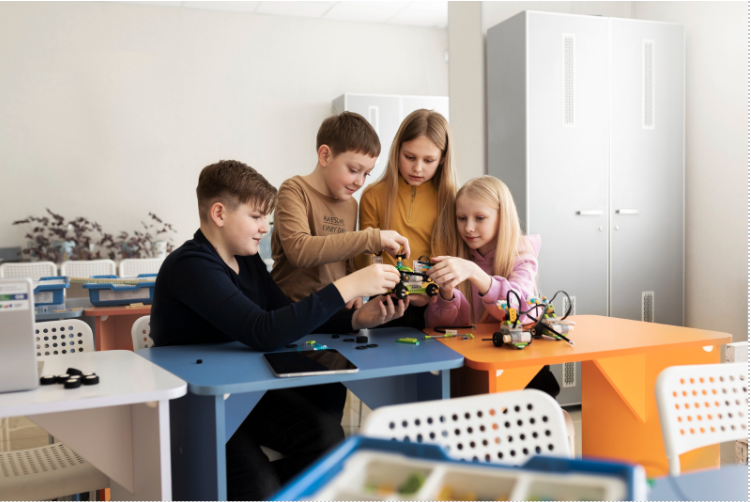
The process often begins with integrating hands-on learning experiences into everyday instruction. Instead of relying solely on textbooks, students participate in experiments, design challenges, coding projects, robotics activities, and collaborative investigations.
A school seeking to understand how to become a STEM enabled school India should prioritize curiosity-driven learning, encourage questioning, and provide opportunities for students to engage with real-world applications of science, technology, engineering, and mathematics.
Critical Thinking Prepares Students for Future Challenges
One example of this would be a student conducting research, making a presentation, or participating in interdisciplinary education to review the various angles or perspectives of an issue before arriving at a reasonable conclusion and presenting evidence supporting that reasoning.
Many educational researchers cite critical thinking as one of the most important skills needed for future professional development. The critical-thinking skill set will provide valuable resources for students as they prepare for the future in technology, medicine, engineering, business, or the development of public policy.
As technology advances through artificial intelligence and automation, the demand for uniquely human characteristics such as creativity, reasoning, morality, and critical thinking will increase in value.
How to Become a STEM Enabled School India by Encouraging Research Skills
A key step in understanding how to become a STEM enabled school India involves strengthening research and analytical learning opportunities. Students should be encouraged to investigate topics independently, collect data, evaluate sources, and present evidence-based findings.
Schools can support this goal by creating maker spaces, innovation labs, STEM clubs, and project-based learning programs. These environments encourage experimentation and help students develop confidence in applying knowledge to practical challenges.
Research-focused learning not only improves academic performance but also helps students develop the problem-solving abilities needed in future careers.
Technology and Information Literacy Become Essential
With the increased adoption of digital technologies in our everyday lives, information literacy has become an important aspect of education today. Students are required to learn how to evaluate the credibility of online information, recognize misinformation, and use digital resources in a responsible manner.
Students will be encouraged by the IB Programme to think critically about information and use ethical methods when conducting research and communicating their findings. This emphasis provides students with the ability to become responsible digital citizens who can successfully navigate complex information environments.
Educational leaders agree that developing information literacy is no longer an option for students. In today's world, where there is an abundance of data available for everyone to access, the ability to evaluate and produce original ideas will determine student success in the classroom and provide them with the ability to make informed decisions.
How to Become a STEM Enabled School India Through Technology Integration
Schools exploring how to become a STEM enabled school India should focus on meaningful technology integration rather than simply increasing device usage. Effective STEM education combines digital tools with inquiry, experimentation, and collaborative problem-solving.
Students should have opportunities to work with coding platforms, robotics systems, engineering challenges, scientific simulations, and emerging technologies. These experiences help bridge the gap between theoretical knowledge and practical application.
By integrating technology into authentic learning experiences, schools can prepare students for the demands of a rapidly evolving economy.
Building Future-Ready Learners
The International Baccalaureate Programme's increased popularity indicates the realization of a need to change education, as it evolves with the changing society and technological advances. Teaching students how to think critically, question, analyze and add to their own knowledge is just as important as teaching the subject content.
Many educators now consider inquiry-based and critical thinking, research skills, and information literacy to be the foundational competency skills for future success in higher education and business.
The IB Programme provides significant information and insight to educators who want to transition to being a STEM-enabled school in India. By promoting curiosity, encouraging independent inquiry, integrating technology in meaningful ways, and putting an emphasis on solving real-world problems, schools can develop a productive learning environment to prepare students for future obstacles.
As the age of unlimited information continues to change the way we educate, there will be more schools that will focus on students developing critical thinking skills and engaging in inquiry-based learning. It aims to offer a better chance to create happy, capable, adaptive and successful learners who can thrive in an increasingly unpredictable world.