How Lodha Oakwood School Nurtures Innovation Through Early STEM Education
Lodha Oakwood School in Mumbai stands as a progressive educational institution committed to nurturing curiosity, creativity, and a strong foundation in experiential learning. With a focus on integrating STEM and STEAM education into everyday academics, the school encourages students to explore concepts through hands-on activities, critical thinking, and real-world problem-solving.
The learning environment at Lodha Oakwood School reflects a forward-thinking approach, where innovation, collaboration, and inquiry-based learning are central to student development. Through well-structured programs and dedicated learning spaces, the school empowers students to transform ideas into meaningful outcomes, preparing them for the challenges of an evolving, technology-driven world.
A Structured and Age-Appropriate STEAM Program
One of the most impressive aspects of Lodha Oakwood School’s approach is its structured STEAM education framework for students from Grade 1 to Grade 5. Each grade level is introduced to carefully planned activities tailored to their cognitive and developmental stage. This ensures that students not only enjoy the learning process but also understand and apply concepts in a meaningful way.
By aligning activities with age-specific capabilities, the school enables students to execute projects confidently while grasping real-world applications of scientific and mathematical principles. This progressive exposure helps build a strong foundation in analytical thinking from an early age.
Learning Through Experimentation and Iteration
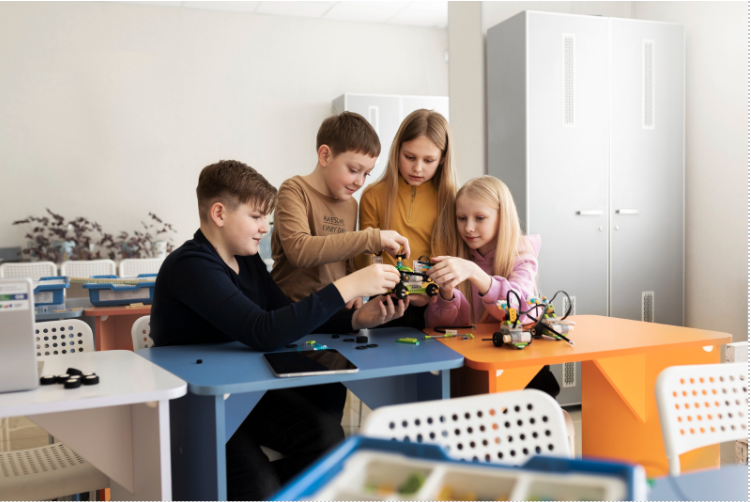
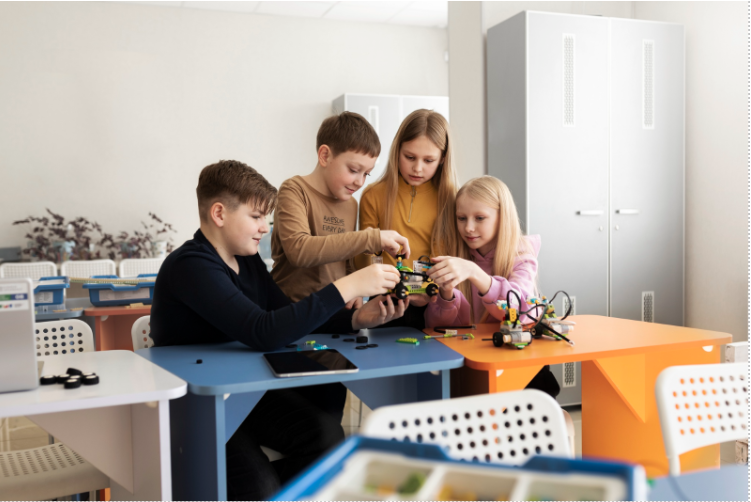
Students are encouraged to experiment with different combinations of materials and components, following a trial-and-error approach that allows them to test, analyse, and refine their ideas independently.
For example, in building projects such as balloon-powered cars or mechanical models, students explore wheel sizes, attachment techniques, and material choices to achieve optimal performance. Through such projects, they learn the importance of design optimisation, functional testing, and iterative improvement.
Preparing for Real-World Challenges
In structured competitions and classroom projects, students are guided to design models that can perform under varying conditions. They test their creations on different surfaces, explore multiple approaches, and refine solutions to maximise efficiency.
This preparation encourages strategic thinking, adaptability, and resilience—skills that extend far beyond classroom learning. It also gives students early exposure to practical engineering constraints and problem-solving in real-world contexts.
Empowering Educators Through Continuous Learning
A strong STEM program is supported by a well-trained and motivated faculty. Teachers at Lodha Oakwood School actively participate in professional development programs, robotics workshops, and research-based learning initiatives.
This ongoing training ensures that educators are equipped to guide students through increasingly complex experiments while fostering creativity and critical thinking. Faculty members also develop innovative teaching methods to simplify problem-solving concepts for younger students, ensuring engagement across all grade levels.
Learning Beyond Competition
Competitions and project-based activities are viewed as opportunities for exploration, collaboration, and knowledge exchange rather than just winning accolades. Students are encouraged to learn from peers, broaden their perspective, and apply concepts in diverse ways.
Looking ahead, students are gradually introduced to building projects from scratch, further strengthening their understanding of fundamental concepts and design thinking.
Integrating STEM Into the Core Curriculum
STEM education at Lodha Oakwood School is seamlessly woven into the regular academic curriculum. Term-wise activities are designed in alignment with subject syllabi, allowing students to connect textbook concepts with hands-on experiences.
This approach transforms theoretical learning into tangible understanding, making education more engaging and relevant. By bridging classroom lessons with real-world applications, students gain clarity on how scientific principles function beyond paper, fostering deeper comprehension and long-term retention.
Showcasing Creativity Through Remarkable Projects
Students engage in a variety of projects that combine creativity, scientific inquiry, and practical problem-solving. Examples include:
- Balloon-powered cars and mechanical models exploring motion and energy transfer
- Water-based instruments demonstrating sound pitch variations
- Light and refraction experiments showing colour behaviour in different media
- Entrepreneurial projects using recycled materials, encouraging early exposure to business concepts
- Biological models demonstrating human anatomy and physiology
- DIY hydraulic loaders and custom-designed trial paths for engineering projects
These projects highlight the school’s emphasis on creativity, sustainability, and applied learning.
Shaping Tomorrow’s Innovators
The programs and practices at Lodha Oakwood School reflect a learning environment that values curiosity, experimentation, and resilience. By introducing hands-on STEM experiences at an early age, the school equips students with skills that will shape their future paths.
As these young learners continue to explore, question, and create, they are empowered to become innovative, capable, and confident individuals ready to face the challenges of a rapidly evolving world. Lodha Oakwood School stands as a strong example of how thoughtful STEM education can nurture the innovators of tomorrow.