
Makers' Muse YSRP
Student Research Program in Ahmedabad
Some students keep asking “but why?” long after the class has moved on. YSRP by Makers’ Muse is a student research program in Ahmedabad that turns that habit into serious work. With an expert mentor guiding each step, students grow a rough idea into a written high school research paper.
- Grade 6 to Grade 12: for school students from about 11 to 18 years old.
- Fully online: whether in Ahmedabad or any other city, every student learns with the same mentorship.
- 8 stages: a clear path from choosing an idea to the final review.
- Domain-expert mentor: teamed up with each student according to research interest and grade.
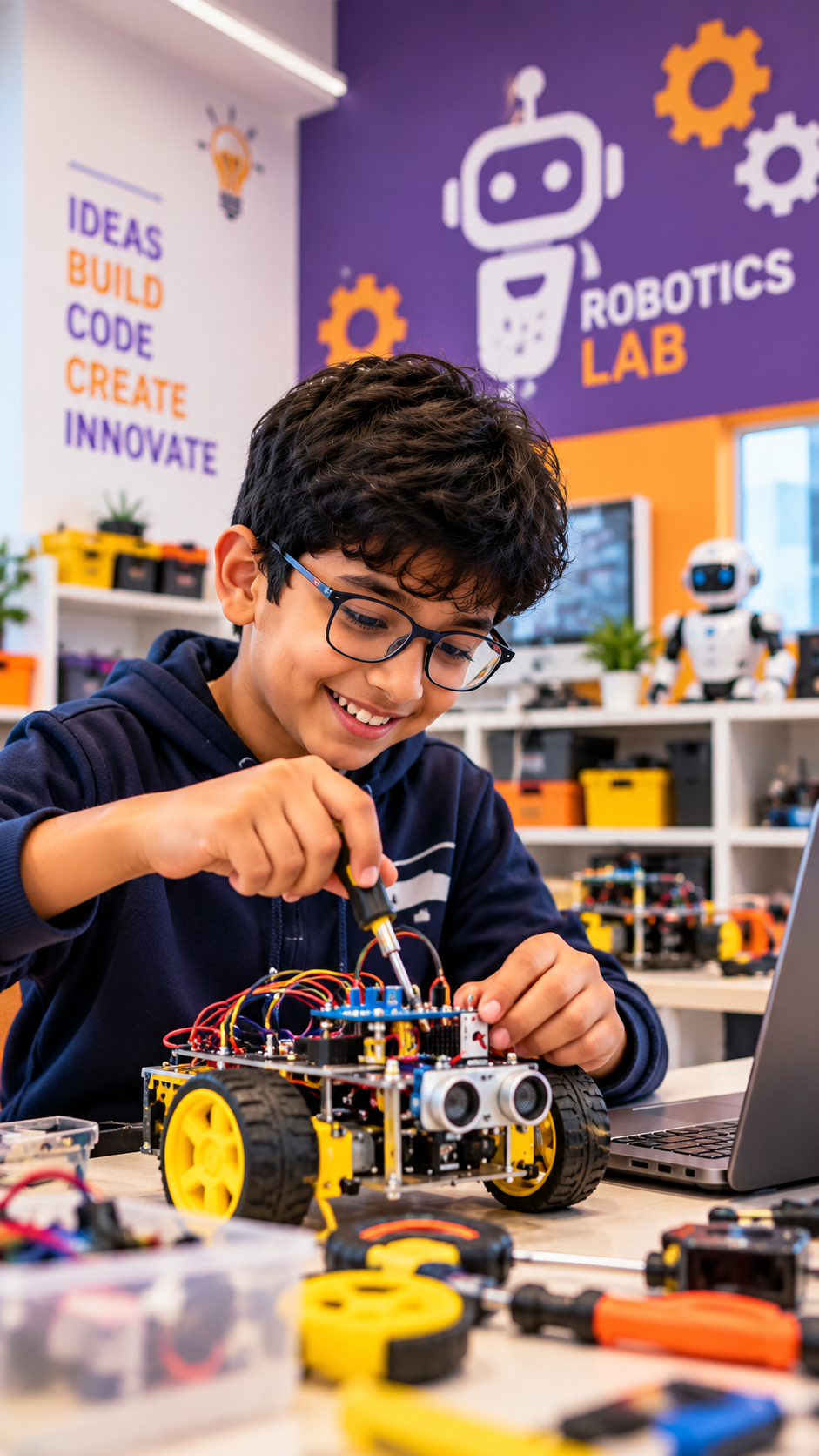
1:1 Mentorship
IIT, MIT & Oxford researchers
Why it matters
Why is it Important to Write a Research Paper?
For Ivy League and university admissions abroad, grades and test scores are the entry fee, not the whole story. Highly selective universities turn down most of their applicants, including plenty with outstanding records. When many profiles read alike, the one that stays in memory shows depth: a particular piece of work with a genuine reason behind it. A research project that ends in something tangible, such as a paper, is one of the strongest ways to show that depth.
Writing “research” in an activities list takes a few seconds. Producing a real paper with your name on it takes sustained effort, and it hands an admissions reader something they can read and verify. For students aiming at the Ivy League and universities abroad, YSRP is built for exactly this gap. Over roughly 8 to 16 weeks, students work with mentors who have real research experience on a project that is truly their own and not a template with someone else’s name swapped out.
If a university in the US, UK or elsewhere overseas is your goal, this student research program in Ahmedabad opens at Grade 6, so research can begin years before application season. YSRP spans AI and computer science, environment, biology, social science and engineering, so the paper can tie in with the course you hope to apply for.
The advantage
The YSRP Advantage: Real Research with Expert Guidance
Most school students never get a look at how genuine academic research is done. YSRP lets them in. It is structured mentorship that walks a student through the entire research lifecycle, so the skills come from doing the work rather than hearing about it.
Along the way, students learn to frame a focused question, build on what others have already found, plan a sound method, analyse data and write a complete manuscript. Because the student leads and the mentor supports, the research stays genuinely theirs. Being able to research independently, interpret data and explain ideas academically also helps a student stand out in competitive applications.
| Advantage | What it means for the student |
|---|---|
| Student-led, mentor-supported | The ideas, analysis and writing are the student’s own, backed by expert guidance at each stage |
| Original data | Findings come from the student’s own work and are analysed and interpreted by them |
| Complete research experience | Every step is covered, from the first question to the final paper |
| Careful review | The work goes through a full academic review before the final send-off |
The roadmap
Student Research Program in Ahmedabad: 8 Stages Toward One Final Paper
A mentor sits at the centre of every stage, so students never have to untangle the complexity on their own. Everyone writing a high school research paper in Ahmedabad through YSRP follows the same eight stages.
Stage 1
Onboarding and interest mapping
Mentors find out what fires up the student and match it to a research domain that fits.
Stage 2
Research question framing
A wide-ranging interest is boiled down to a focused question that suits the school level. Mentors help trim any question that tries to cover too much.
Stage 3
Literature review
Students read academic journals and earlier studies to locate what is still unknown. For many, it is the first academic reading they do beyond textbooks, and it builds critical analysis and citation awareness.
Stage 4
Methodology design
Students choose how to go about answering the question, whether through surveys, experiments, data collection systems, coding projects or sensor builds. Mentors keep the method rigorous and doable.
Stage 5
Research execution
The experiment runs, the survey goes out and the data begins to arrive, with technical checks that the method stands up.
Stage 6
Data analysis
Students turn results into findings using tools such as Python, Excel or statistical software, supported by comparisons and clear visuals.
Stage 7
Paper writing
The findings are assembled into a formal paper: introduction, literature review, methodology and results. Mentors give feedback on structure, clarity, academic tone, logical flow and citation accuracy.
Stage 8
Review and final wrap-up
After academic review, the paper is prepared for a journal, conference or platform that suits student research.
Research domains
Research Domains for a Research Paper in Ahmedabad
YSRP stretches across many academic fields, so each student can link their research to an interest they want to keep exploring. Makers’ Muse helps students explore these domains:
| Subject Name | What It Is About |
|---|---|
| AI and machine learning | Building systems that learn from patterns in data, so tasks can be automated and decisions supported. |
| Data science and statistics | Gathering and making sense of numbers to uncover trends and inform choices. |
| Computer science and cybersecurity | Creating software and guarding systems, networks and data against digital threats. |
| Robotics and automation | Designing, building and programming machines that carry out tasks independently or with limited human help. |
| Electronics, IoT and sensor systems | Connecting physical devices with sensors and microcontrollers so data can be captured and sent in real time. |
| Environmental science and climate | Studying ecosystems, pollution and climate patterns to understand human impact and find ways to lessen it. |
| Renewable energy and sustainable cities | Developing clean energy and urban planning ideas that help communities save resources and live more sustainably. |
| Health and biomedical sciences | Looking into the human body, disease and medical treatment to improve public health and care. |
| Neuroscience and cognitive science | Understanding the nervous system and the brain, along with mental processes like memory, learning and perception. |
| Biology, genetics and life sciences | Exploring living organisms, how cells are built, how genes are expressed and how biological systems work. |
| Physics and space science | Studying matter, motion, energy and the celestial bodies that make up the universe. |
| Psychology and behavioural science | Examining how people think, feel, behave and interact, to explain what individuals and groups do. |
| Economics, business and finance | Analysing markets, financial systems, trade, how consumers behave and how businesses operate. |
| Public policy, education and sociology | Looking at how societies are organised, how governance rules work and how community programmes tackle social issues and support public wellbeing. |
| Linguistics, literature and humanities | Exploring how language is structured, how culture is expressed, how people communicate and how human history is told through writing and speech. |
A good topic is narrow. For example: can a simple sensor-based system cut water waste in a school’s rooftop garden, compared with manual watering over a month?
Your mentors
Learn from IIT, MIT and Oxford Researchers, PhD Scholars and Industry Experts
Every YSRP student is paired with researchers, PhD scholars and industry experts from institutions including the IITs, MIT and Oxford, who personally coach them through every step of the research journey. Makers’ Muse mentors come from varied backgrounds, from research to engineering to industry practice, so a student exploring AI, the environment or engineering is guided by someone fluent in that field.
For a student writing a research paper in Ahmedabad, this means expert support from the very first conversation.
How mentoring works
Mentoring starts with interest mapping, a feasibility check on the topic and domain matching. From there, mentors help students:
- Shape specific questions that can be researched
- Pick methods that are rigorous yet achievable
- Interpret their data
- Write the paper section by section
The mentor guides, questions and gives feedback; the student does the research and the writing.
Proof from Ahmedabad
Add a School’s Feedback
Real, permissioned feedback from a Ahmedabad school or student, with date and context.
School feedback, student quote or project photo (with permission, date and school name)
Get started
How to Join the Student Research Program in Ahmedabad
If your child is curious about research, this student research program in Ahmedabad works with CBSE, ICSE, IB and Cambridge, and is part of the flexible Makers’ Muse approach, which weaves research, hands-on projects and mentorship into a pathway shaped around each student.
The first step is a conversation about the student’s interests and timeline. Makers’ Muse offers a research readiness conversation and a topic feasibility conversation, so you find out early whether an idea can grow into a workable research paper.
Research readiness conversation
A first talk about the student’s interests and timeline.
CBSEICSEIBCambridge
Topic feasibility conversation
Find out early whether an idea can grow into a workable research paper.
No finished topic needed
Student Research Program in Ahmedabad: Frequently Asked Questions
Yes. YSRP is a research mentorship programme for school students in Grades 6 to 12. It is built on an 8-stage research journey, and every student is paired with a mentor who is an expert in their domain.
YSRP is a structured program. You move along an eight-stage roadmap from interest mapping to the final review, with one dedicated mentor working with you throughout. Mentors are doctoral researchers, postdocs and faculty from institutions including the IITs, IIMs, NITs, MIT and Oxford. The program spans research domains, supports CBSE, ICSE, IB and Cambridge students, and offers an individual plan as well as a school cohort plan. Mentors guide and give feedback, but the work remains yours.
It can. Many applicants have strong grades and similar activities, so genuine research work helps you stand apart. With YSRP, you finish with a research paper, a digital completion certificate and a personalised recommendation letter from your mentor, who has worked with you one-on-one for weeks. You can also draw on your methods, data and findings in your essays and statement of purpose, rather than simply stating a general interest.
Choose a topic that excites you and narrow it down to one question you can test. Then read existing studies, pick a method, collect data and write up what you find. YSRP takes you through these eight stages, and you do not need a finished topic to begin.
Yes. YSRP is accessible for Grades 6 to 12, so a student in Ahmedabad or any other Indian city receives the same one-to-one mentorship. It runs for roughly 8 to 16 weeks and fits CBSE, ICSE, IB and Cambridge.
Research isn’t a requirement, and it can’t stand in for strong grades or essays. What it does is show the curiosity and independent thinking that selective universities value. Because each university has its own expectations, check the guidelines of the ones you apply to.
YSRP covers many domains, including AI, computer science, robotics, environment, health, social science, physics, biology and linguistics. Start with something that sparks your curiosity and narrow it down, for example, AI-based waste segregation or air quality in your neighbourhood.
It adds depth and gives you real material for essays, recommendations and interviews, while showing skills like analysing data and communicating findings clearly. It cannot win admission on its own, but it helps your profile hold its own next to your grades.
Join the Student Research Program in Ahmedabad
Take your curiosity from a first idea to a high school research paper in Ahmedabad, with mentors beside you until the final stage.