
Makers' Muse YSRP
Research Program for Students in Delhi NCR
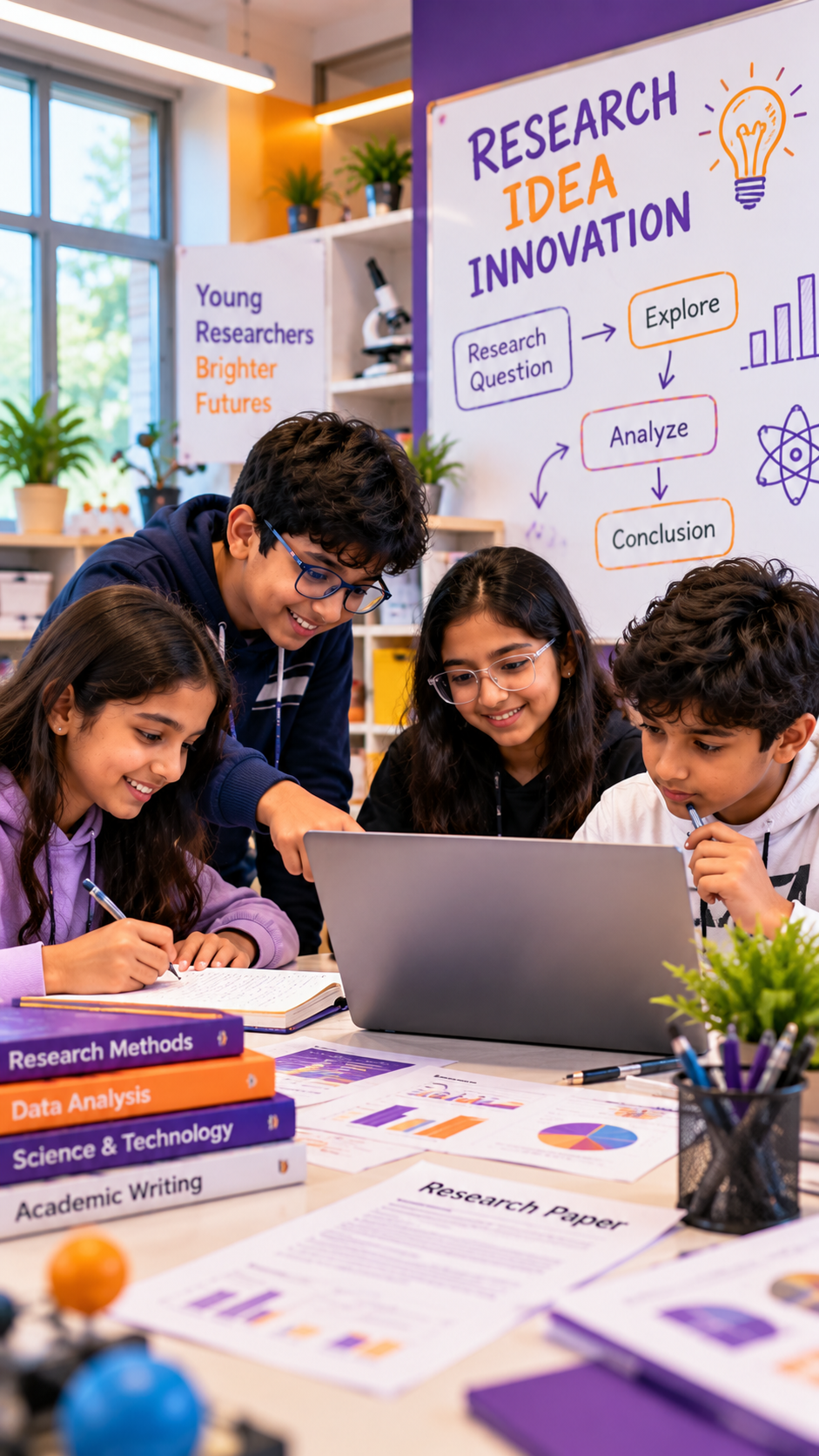
Plenty of students in Delhi NCR are ready for questions that no school project can hold. YSRP by Makers’ Muse is a research program for students in Delhi NCR that gives those questions real room to grow. With an expert mentor guiding every stage, a student goes from a rough first idea to a written high school research paper.
- Grade 6 to Grade 12: open to school students from about 11 to 18 years old.
- Fully online: students in Delhi NCR get the same mentorship as students in any other city.
- 8 stages: a clear path from choosing an idea to the closing review.
- Domain-expert mentor: paired with each student by research interest and grade.
1:1 Mentorship
IIT, MIT & Oxford researchers
Why it matters
Why Do Students Need to Write a Research Paper?
At the Ivy League, Oxford and Cambridge, the great majority of high-scoring applicants are still turned away. Excellent marks stop being an advantage and become the minimum entry requirement. To rise above the crowd, a student needs something that sets them apart, and very little signals academic promise like following an original question all the way to a finished, review-ready research paper.
Listing clubs and titles on a resume takes little effort. Seeing a full manuscript through to the end shows a maturity that is genuinely uncommon. YSRP is designed to walk students through exactly that journey. Across 8 to 16 weeks, they work closely with experienced researchers on projects that are their own, not copies of a standard blueprint.
For families focused on top overseas universities, this research program for students in Delhi NCR welcomes students from Grade 6, giving them years to build real depth well before deadlines arrive. With tracks across areas such as AI, computer science, biology, environmental science, social science and engineering, YSRP lets students shape work that supports the career path they have in mind.
The advantage
The YSRP Advantage: Real Research with Expert Guidance
Most school students never get a close look at how real academic research is done. YSRP lets them in. It is structured mentorship that carries a student through the entire research lifecycle, so the skills are built by doing the work rather than by reading about it.
Along the way, students learn to shape a sharp question, draw on earlier studies, plan a sound method, analyse data and write a complete manuscript. The student leads and the mentor supports, so the research stays truly theirs. Being able to research independently, make sense of data and explain ideas academically also helps a student stand out in competitive applications.
| Advantage | What it means for the student |
|---|---|
| Student-led, mentor-supported | The ideas, analysis and writing belong to the student, backed by expert guidance throughout |
| Original data | Findings come from the student’s own work, which they analyse and interpret themselves |
| Complete research experience | Every step is covered, from the first question to the final paper |
| Careful review | The work goes through a full academic review before the final send-off |
The roadmap
Research Program for Students in Delhi NCR: 8 Stages Toward One Final Paper
A mentor guides every stage, so no student has to work through the complexity alone. Everyone writing a high school research paper in Delhi NCR through YSRP follows the same eight stages.
Stage 1
Onboarding and interest mapping
Mentors find out what drives the student and link it to a research domain that suits them.
Stage 2
Research question framing
A big, loose curiosity becomes a focused question that works at school level. Mentors help cut back any question that tries to cover too much.
Stage 3
Literature review
Students go through academic journals and earlier studies to find what is still unanswered. For many it is their first academic reading outside textbooks, and it builds critical analysis and citation awareness.
Stage 4
Methodology design
Students choose how to investigate, whether through surveys, experiments, data collection systems, coding projects or sensor builds. Mentors keep the plan rigorous and realistic.
Stage 5
Research execution
The experiment goes ahead, the survey is circulated and the data starts to arrive, with technical checks that the method is sound.
Stage 6
Data analysis
Students turn raw results into findings using tools such as Python, Excel or statistical software, supported by comparisons and clear visuals.
Stage 7
Paper writing
The findings come together as a formal paper with an introduction, literature review, methodology and results. Mentors give feedback on structure, clarity, academic tone, logical flow and citation accuracy.
Stage 8
Review and final wrap-up
After academic review, the paper is made ready for a journal, conference or platform that suits student research.
Research domains
Research Domains for a Research Paper in Delhi NCR
YSRP stretches across many academic fields, so each student can connect their research to an interest they want to keep growing. Examples from Makers’ Muse:
| Subject Name | What It Is About |
|---|---|
| AI and machine learning | Building systems that learn from patterns in data, so tasks can be automated and decisions supported. |
| Data science and statistics | Gathering and interpreting numbers to reveal trends and guide smarter choices. |
| Computer science and cybersecurity | Creating software and guarding systems, networks and data against digital threats. |
| Robotics and automation | Designing, building and programming machines that carry out tasks on their own or with limited human help. |
| Electronics, IoT and sensor systems | Linking physical devices through sensors and microcontrollers to capture and share data in real time. |
| Environmental science and climate | Studying ecosystems, pollution and climate patterns to understand human impact and look for ways to lessen it. |
| Renewable energy and sustainable cities | Working on clean energy and city-planning ideas that help communities conserve resources and live more sustainably. |
| Health and biomedical sciences | Investigating the human body, disease and medical treatment to improve public health and care. |
| Neuroscience and cognitive science | Understanding the nervous system, the brain and mental processes such as memory, learning and perception. |
| Biology, genetics and life sciences | Exploring living organisms, cell structure, gene expression and the workings of biological systems. |
| Physics and space science | Studying matter, motion, energy and the celestial bodies across the universe. |
| Psychology and behavioural science | Examining how people think, feel and interact, to explain the behaviour of individuals and groups. |
| Economics, business and finance | Analysing markets, financial systems, trade, consumer behaviour and the running of businesses. |
| Public policy, education and sociology | Exploring how societies are organised, how governance works and how community programmes address social issues and public wellbeing. |
| Linguistics, literature and humanities | Exploring how language is built, how culture is expressed, how people communicate and how history is told through writing and speech. |
A good topic is narrow. For example: can a simple sensor-based system reduce water waste in a school’s rooftop garden, compared with manual watering over one month?
Topic ideas
Some Research Topic Ideas for Delhi NCR Students
These sample questions show the level of focus a strong topic needs. They are illustrations, not fixed topics, and mentors help each student shape their own.
Sample question
Environment
How do air-quality readings differ between a busy roadside and a quiet residential lane at the same time of day?
Sample question
Data science
What seasonal patterns appear in public air-quality data across the months of a year?
Sample question
Public policy
How does a student’s commute mode, such as the metro, bus or school transport, relate to the time they spend travelling to school?
Sample question
Linguistics
How do teenagers blend Hindi and English in their messages?
Sample question
AI
Can AI-based image recognition improve waste segregation in schools?
Your mentors
Learn from IIT, MIT and Oxford Researchers, PhD Scholars and Industry Experts
Every YSRP student is paired with researchers, PhD scholars and industry experts from institutions including the IITs, MIT and Oxford, who personally coach them through every step of the research journey. Makers’ Muse mentors bring varied backgrounds, from research to engineering to industry practice, so a student exploring AI, the environment or engineering is guided by someone fluent in that field.
For a student writing a research paper in Delhi NCR, that means expert help from the very first conversation.
How mentoring works
Mentoring opens with interest mapping, a feasibility check on the topic and domain matching. From there, mentors help students:
- Shape specific questions worth researching
- Choose methods that are rigorous yet achievable, make sense of their data
- Write the paper section by section
The mentor guides, questions and gives feedback; the student does the research and the writing.
Proof from Delhi NCR
Add a School’s Feedback
Real, permissioned feedback, student projects or photos from this school, with date and context.
School feedback, student quote or project photo (with permission, date and school name)
Get started
How to Join the Research Program for Students in Delhi NCR
If your child is curious about research, this research program for students in Delhi NCR works with CBSE, ICSE, IB and Cambridge, and is part of the flexible Makers’ Muse approach, which blends research, hands-on projects and mentorship into a pathway shaped around each student.
The first step is a conversation about the student’s interests and timeline. Makers’ Muse offers a research readiness conversation and a topic feasibility conversation, so you learn early whether an idea can grow into a workable research paper.
Research readiness conversation
A first talk about the student’s interests and timeline.
CBSEICSEIBCambridge
Topic feasibility conversation
Find out early whether an idea can grow into a workable research paper.
No finished topic needed
Research Program for Students in Delhi NCR: Frequently Asked Questions
Yes. YSRP is a research mentorship programme for school students in Grades 6 to 12. It follows an 8-stage research journey, and each student is paired with a mentor who is an expert in their domain.
YSRP is a structured program. You move through an eight-stage roadmap from interest mapping to the final review, with a dedicated one-on-one mentor beside you all the way. Mentors are doctoral researchers, postdocs and faculty from institutions including the IITs, IIMs, NITs, MIT and Oxford. The program covers research domains, supports CBSE, ICSE, IB and Cambridge students, and comes with an individual plan as well as a school cohort plan. Mentors guide and give feedback, but the work remains yours.
It can. Plenty of applicants have strong grades and similar activities, so genuine research work helps you stand apart. With YSRP, you finish with a research paper, a digital completion certificate and a personalised recommendation letter from your mentor, who has worked with you one-on-one for weeks. You can also use your methods, data and findings in your essays and statement of purpose rather than only stating a general interest.
Choose a topic that excites you and narrow it into one question you can test. Then read existing studies, pick a method, collect data and write up your findings. YSRP takes you through these eight stages, and you do not need a finished topic to begin.
Yes. YSRP is accessible for Grades 6 to 12, so a student in Delhi NCR or any other Indian city receives the same one-to-one mentorship. It runs for roughly 8 to 16 weeks and fits CBSE, ICSE, IB and Cambridge.
Research isn’t a requirement, and it can’t make up for weak grades or essays. What it does show is the curiosity and independent thinking that selective universities value. Because each university sets its own expectations, check the guidelines of the ones you apply to.
YSRP covers many domains, including AI, computer science, robotics, environment, health, social science, physics, biology and linguistics. Begin with something you are curious about and narrow it down, for example AI-based waste segregation or air quality in your neighbourhood.
It adds depth and gives you real material for essays, recommendations and interviews, while showing skills like analysing data and explaining findings clearly. It can’t secure admission on its own, but it helps your profile stand out next to your grades.
Join the Research Program for Students in Delhi NCR
Take your curiosity from a first idea to a high school research paper in Delhi NCR, with mentors beside you until the final stage.