
You Don’t Need to Be a Topper to Invent Something: The Biggest Myth About Young Innovators
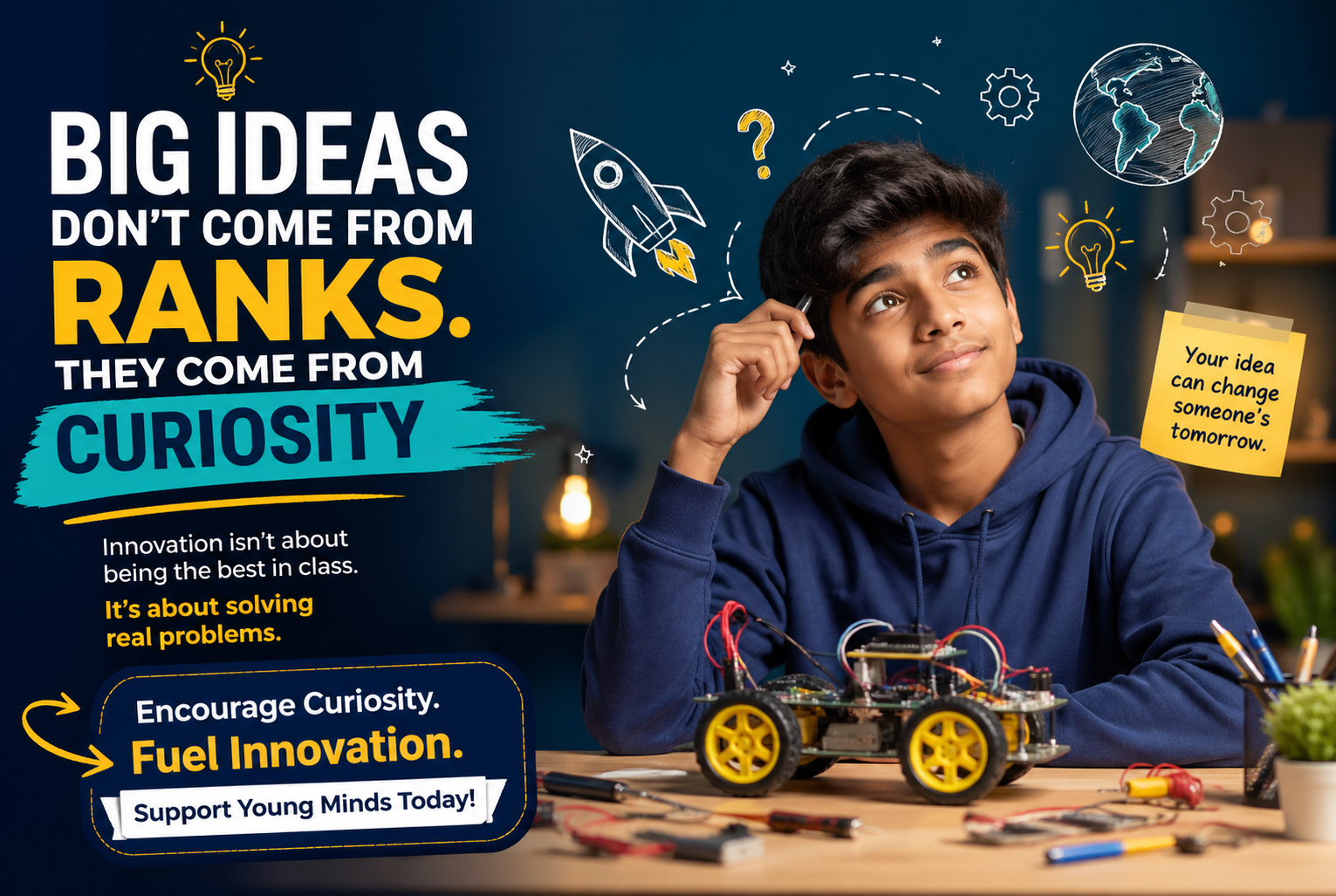
Many children hold an unspoken belief that if you aren’t in the top 10% of your class, you aren’t smart enough to be an innovator. The idea is embedded in conversations with children from an early age through report cards, ranking and comparing their accomplishments to others; and eventually it becomes a basis for what children think they will be able to do in life.
Historically, innovators have never been limited to the best test takers. Innovators are those who notice problems, question how things work and continue trying until they figure out the solution. This distinction is more important today than ever as STEM (Science, Technology, Engineering & Math) education and STEM-focused learning continue to shape the educational system.
The Myth – “Only Toppers Can Innovate”
The belief that only the best/talented students can become inventors stems from the traditional education system through rankings, exams, and visible rewards. It focuses on a very narrow definition of success.
This idea discourages many children from seeing themselves as creators or problem- solvers. This creates an artificial line between “high scorers” and “innovators” when, in fact, there is not a direct connection.
How Academic Labels Shape Early Thinking
The way that many children are labelled will begin to influence their thinking as soon as they enter the school system.
Children who were not at the very top will often assume that they cannot create or innovate. This creates limited exploration even before they are able to experience hands-on learning opportunities.
Why This Myth Feels True but Is Misleading
| Perception | Reality |
| Toppers are naturally more capable | Capability depends on skill type |
| High marks equal creativity | Creativity is not measured in exams |
| Innovation needs academic excellence | Innovation needs problem-solving ability |
Academic success is highly visible, while innovation often develops quietly through experimentation and failure. This creates a misleading connection between marks and inventive ability.
What Creates Young Innovators
Long before you can be a technical expert, you can start innovating. A child sees a problem and questions it, wanting to see how it functions in a way that extends beyond the textbook.
Innovating is different from preparing for an exam. In an exam, success depends on reaching the correct answer quickly and efficiently. Innovation, on the other hand, is an open-ended process where you explore multiple possibilities, test ideas, and iterate continuously until you arrive at a solution that truly works for your context.
Curiosity Driven Thinking
- Curious thinking leads to innovation. A child who questions the day-to-day systems around them will be curious to learn more and to seek further solutions.
- This type of curiosity will be encouraged in every STEM learning environment by encouraging students to question rather than memorise answers.
Learning Through Experimentation
- Innovators do not avoid mistakes. They use them as part of the learning process.
- Each attempt provides feedback that improves the next version of an idea.
- This iterative process builds resilience, confidence, and a stronger problem-solving ability over time.
Cross-Subject Thinking in STEM Education
Innovation rarely comes from a single subject. It requires combining multiple areas of knowledge.
For example, building a simple automated system may involve,
- Scientific understanding of motion
- Mathematical calculations for accuracy
- Logical sequencing for automation
- Design thinking for usability
This interdisciplinary structure is a core principle of STEM education.
Why Academic Excellence Does Not Guarantee Innovation
Academic systems are designed to measure performance in controlled environments. Innovation, however, requires flexibility and uncertainty, which are not always reflected in exam formats.
This creates a gap between what is rewarded in school and what is needed to create new ideas or solutions.
What Academic Systems Measure vs What Innovation Needs
| Academic Success Measures | Innovation Requires |
| Accuracy and speed | Exploration and patience |
| Memorisation | Concept application |
| Fixed answers | Open-ended thinking |
| Exam performance | Real-world problem-solving |
Different Thinking Styles
Successful students tend to be very good at doing things in an orderly manner with quite a lot of instructions. Innovators are more at ease with an uncertain environment and learning by trial-and-error. Both of these types of employees represent important skills, but they have differing uses. Innovation is more about discovering new things than doing things over and over again.
How Young Innovation Actually Develops
There is no such thing as an instantaneously developed innovative ability. It comes from ongoing exposure to a variety of experiences. It occurs through continued practice and the freedom to express creativity and generate ideas without any concerns about making mistakes. As children are allowed to create and test their ideas, they will continue to develop their problem-solving abilities over time.
Role of Hands-On Learning
- Experiential learning supports the connection between the concept of a theory and the act of applying the concept in practice with respect to method.
- Using this process helps to create both a stronger understanding and retention of the subject matter.
- In terms of STEM education, experiential learning (or hands-on learning) is the primary learning method used to develop skills that are used in the real world.
Importance of Iterative Thinking
- Innovation involves repeated cycles of improvement. Children learn that ideas evolve over time through continuous refinement.
- This approach builds patience and teaches them that progress is more important than perfection.
Building Confidence Through Creation
When children create something on their own, their confidence increases significantly. They begin to trust their ability to solve problems independently.
How STEM Education Breaks the “Topper Myth”
STEM education plays a major role in breaking the belief that only top scorers can innovate. It introduces structured yet flexible learning environments where every child can participate.
This shifts the focus from marks to capability development.
Passive Learning to Active Building
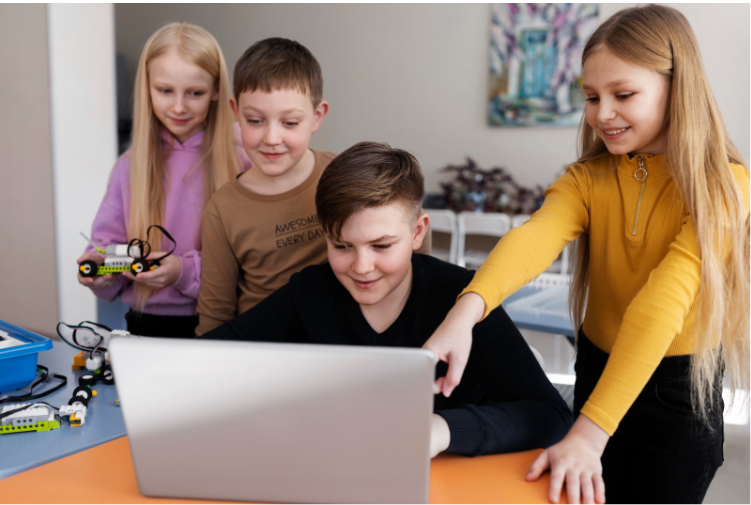
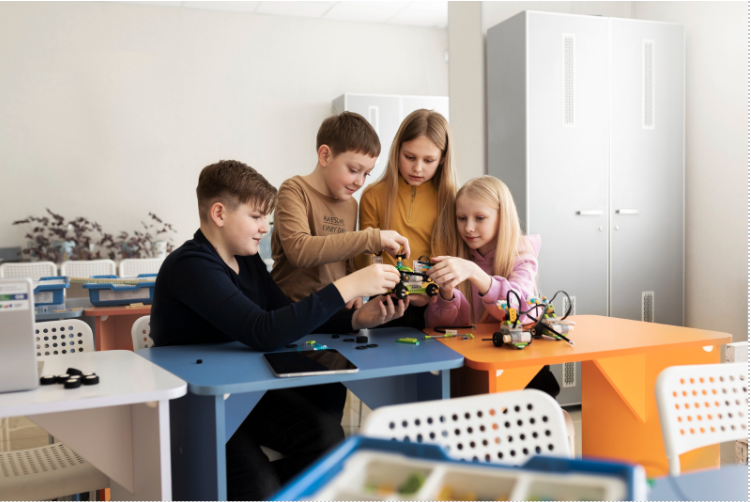
Traditional learning focuses on receiving information. STEM-based learning encourages active participation through building and experimentation.
Children engage in,
- Problem-solving activities
- Project-based learning tasks
- Simulation and model-building exercises
Equal Opportunity for All Learners
| Traditional System | STEM Learning System |
| Rank-based recognition | Skill-based recognition |
| Limited experimentation | Open-exploration |
| Fixed learning paths | Flexible learning journeys |
| Exam-driven progress | Project-driven progress |
This structure ensures that innovation is not limited to toppers alone.
Redefining Who Can Be an Innovator
Innovation should not be seen as a reward for academic excellence. It should be seen as a skill developed through curiosity and practice. Children at all academic levels can become innovators if they are given the right environment and exposure.
Multiple Forms of Intelligence
- Children think differently. Some are analytical, some are visual thinkers, and others are strong in experimentation or design.
- A system focused only on academic ranking misses these diverse strengths.
Creating Space for Exploration
Encouraging children to explore without fear of failure helps unlock their creative potential. This is essential for building long-term interest in STEM learning and STEM education.
Final Thoughts
It’s a common misconception that only students (toppers) are able to invent or innovate. This perception of invention is built on the old education model of ranking students by their grades and percentages. Innovation has more to do with being curious, motivation, and learning through experience rather than your academic performance.
Every child has the capability of creating something by being able to engage in STEM (science, technology, engineering and mathematics) through the education system. The only true differences between children becoming creators or inventors are the attitude and available opportunities.