

AI Prompt Engineering – Skill Shaping Modern STEM Education
As digital tools become a part of everyday learning, STEM education is expanding to include skills that go beyond textbooks and traditional subjects. One such important skill is AI prompt engineering, which teaches students how to interact effectively with artificial intelligence tools. For students aged 12–17, this is not about complicated technology, but about learning how to ask better questions and give clear instructions.
Understanding how to communicate with AI helps students become more confident learners. It also allows them to explore subjects in a more engaging and personalised way. This makes AI prompt engineering a valuable addition to modern learning environments focused on real-world readiness.
What is AI Prompt Engineering?
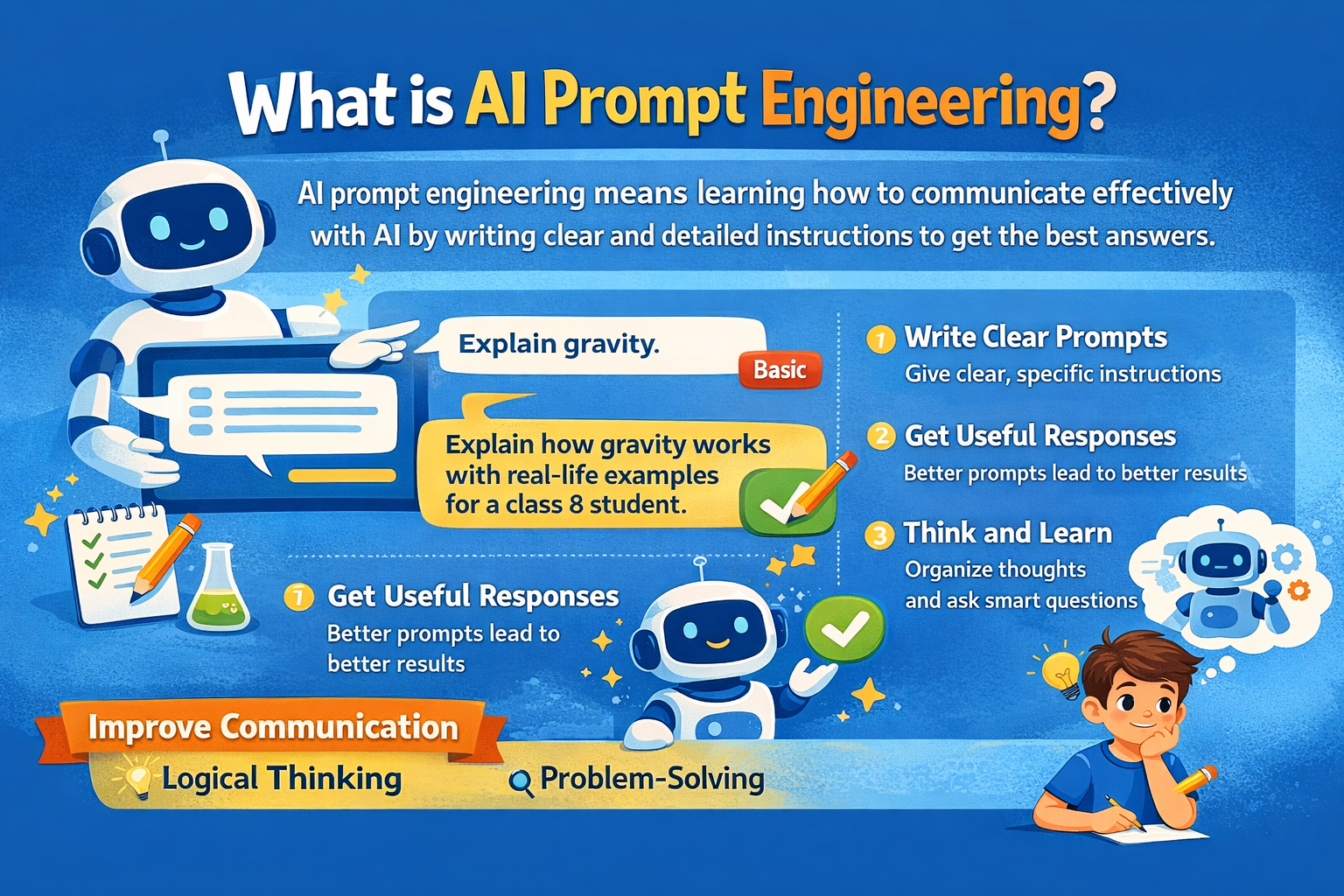
AI prompt engineering is the process of writing clear and structured instructions that guide an AI tool to give useful and accurate responses. It is similar to asking a well-formed question in class, where the quality of the answer depends on how clearly the question is asked. This concept is simple to understand but powerful in practice, especially within STEM education.
When students use vague instructions, they often receive unclear or general answers. However, when they provide specific details, context, and purpose, the AI is able to generate more relevant and helpful responses. For example:
- Basic prompt: “Explain gravity.”
- Improved prompt: “Explain how gravity works with real-life examples for a class 8 student.”
This difference helps students understand the importance of clarity and structure. It also shows how small improvements in wording can lead to better outcomes.
Over time, students begin to:
- Organise their thoughts before asking questions
- Focus on what they really want to learn
- Communicate ideas more effectively
These habits strengthen both academic performance and everyday communication skills.
How to Use AI Prompt Engineering – Step-by-Step
Using AI prompt engineering effectively involves a few simple but important steps. The first step is to clearly understand the goal. Students must decide what they want from the AI, whether it is an explanation, a list, a summary, or a creative output. Having a clear objective makes the prompt more focused and useful.
The next step is to add details and context. This is where students improve the quality of their instructions by including specific information. For example:
- Topic (What is the subject?)
- Level (Who is it for?)
- Format (List, paragraph, story, etc.)
- Purpose (Homework, project, revision, etc.)
A well-structured prompt could look like:
“Give five key points on climate change for a school presentation in simple language.”
The final step is to review and refine the prompt. If the answer is not clear or complete, students should adjust their wording and try again. This teaches an important learning process:
- Try → Observe → Improve → Repeat
This step-by-step method builds patience and problem-solving skills. It also helps students understand that better inputs lead to better results
Why AI Prompt Engineering is Important in STEM Education
A strong STEM education focuses on building thinking skills rather than memorisation. AI prompt engineering supports this by encouraging students to think carefully about how they ask questions and solve problems. It transforms learning into a more interactive and thoughtful experience.
When students work with AI tools, they actively engage in a process similar to scientific learning. They:
- Ask questions
- Test different approaches
- Analyse the results
- Improve their method
This approach helps students develop a deeper understanding of subjects instead of simply remembering facts. It also builds confidence, as students see that they can guide technology to get the results they need.
In addition, AI prompt engineering prepares students for future environments where technology plays a major role. It ensures that students are not just passive users, but active thinkers who can use tools effectively and responsibly.
Skills Students Develop Through AI Prompt Engineering
AI prompt engineering helps students build a wide range of skills that are useful across subjects and in real life. These skills go beyond academics and support overall development.
Key skills include:
- Clear Communication
Students learn how to express ideas in a structured and meaningful way. This improves both writing and speaking skills.
- Logical Thinking
Creating prompts requires step-by-step thinking, which strengthens reasoning abilities in subjects like math and science.
- Creativity
Students can experiment with ideas, generate stories, and explore different perspectives using AI tools.
- Independent Learning
They become more confident in finding answers on their own, reducing dependence on direct instruction.
- Problem-Solving
By refining prompts, students learn how to improve results through trial and error.
These skills are essential for success in modern STEM education and future careers.
AI Prompt Engineering at Makers’ Muse
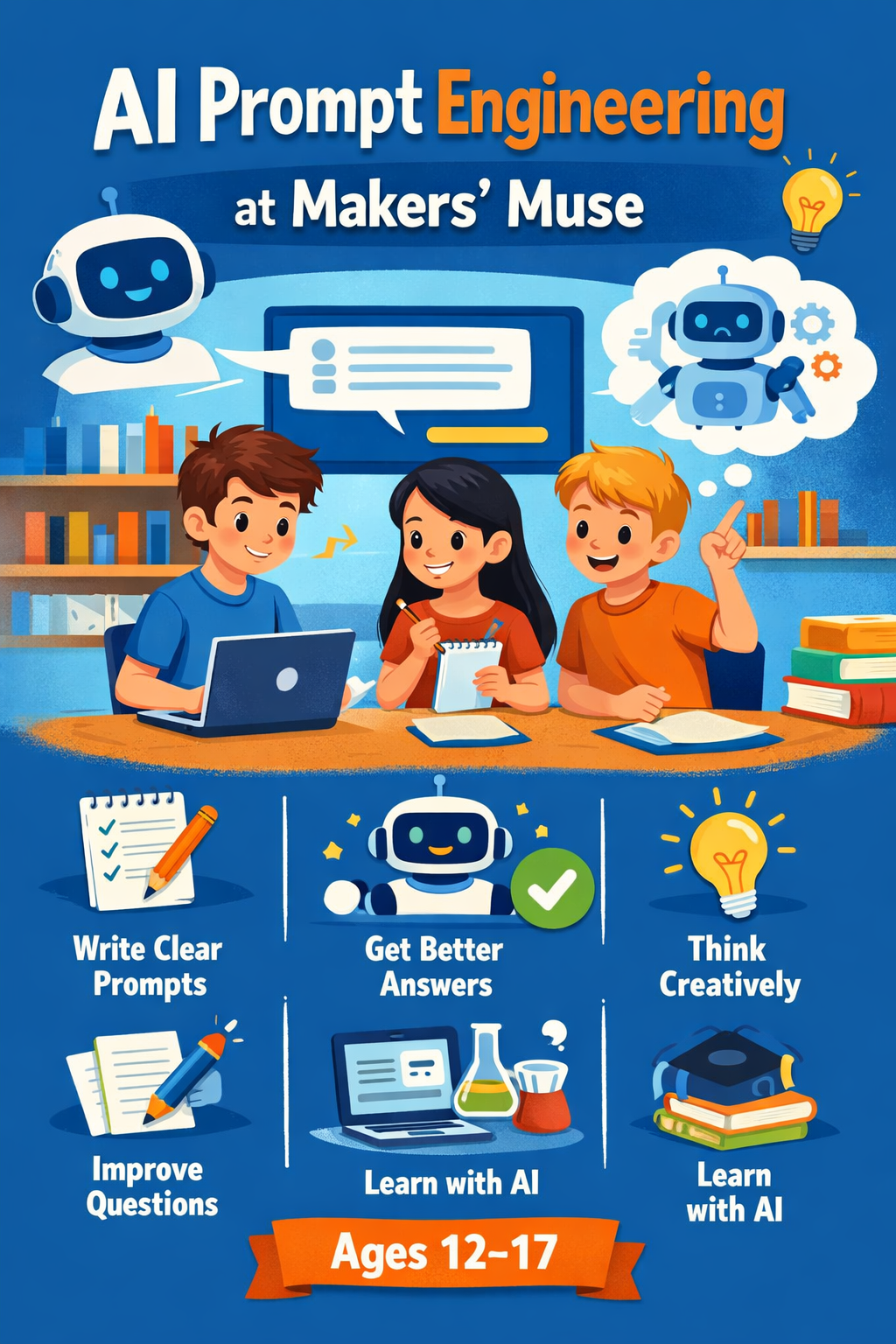
At Makers’ Muse, AI Prompt Engineering is introduced as a simple and practical skill that helps students understand how to communicate with AI tools. The focus is on learning how clear instructions lead to better and more useful answers. Students are shown that AI is not complicated – it simply responds to the way questions are asked.
This program is designed for students aged 12–17, who are naturally curious and ready to explore new technologies. The learning approach is hands-on, so students improve by trying, observing, and refining their prompts step by step.
Students learn:
- How to write clear and specific instructions for AI tools
- How different prompts create different results
- How to improve answers by rephrasing questions
- How to use AI for school subjects and creative tasks
- How to think logically before asking a question
- How to build confidence in using digital tools
- How AI can support learning, not replace thinking
This approach helps students develop AI literacy, creativity, and future-ready tech skills in a simple and engaging way.
Conclusion
AI prompt engineering is a simple yet powerful skill that fits naturally into modern STEM education. It teaches students how to think clearly, communicate effectively, and use technology with purpose. These are essential abilities in today’s learning environment.
For students aged 12–17, this skill provides a strong foundation for future growth. It encourages curiosity, builds confidence, and promotes independent thinking. Most importantly, it helps students move from simply using technology to truly understanding and controlling it.